This information was co-produced with children, young people, parents and research staff in the Ci2i Project to improve experiences of taking part in eye and vision research.
We would really value your feedback to help us understand whether this new information 'What 2 expect' has made a difference to your research experiences. If you are willing, please complete this short survey:
Tell us your views on the Research Test and Assessment Directory

-
A-Z
Your A to Z for understanding the ‘who’ ‘what’ ‘why’ and ‘how’ for common research tests and assessments. . .
A
Accountability
Why do we do this? Accountability is where we record how much of your research treatment has been used or taken. This helps us understand if the treatment is being used or taken as it has been prescribed (for example as often as it should be). It is important for the researchers to know this when they are analysing the results.
What do you do? Usually, you will bring back your empty packets or bottles of treatment, or some other way of us counting or measuring how often the research treatment has been used or taken.
How will it feel? If we don't have anything to count or measure, there will be no direct effect on you; however, it will be very hard for us to perform 'accountability', if we don't have anything to count or measure. It is an important step in the research process. Please bring these items back if you are asked to.
Adaptive Optics
Why do we do this? This is a special kind of imaging that looks at the deepest layer of the eye cells called photoreceptors. It allows us to see if these cells are healthy.
What do you do? You will be sitting in a chair with you head against the headrest and your chin on the chinrest. Your eyes will need to focus on the red cross inside the red box - only focus on the cross! The red box will move and disappear. We will count down from 3, hold your gaze without blinking for these 3 seconds!
How will it feel? You might feel like you are looking at something for a long time, your eyes may get tired. Holding your gaze for 3 seconds may be the hardest part of this test - but if you really need to, you can blink!
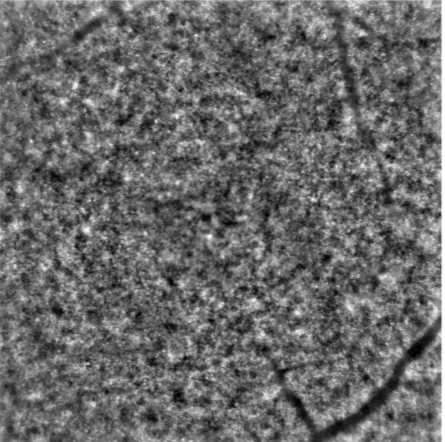
Here is what the photoreceptor cells look like:
Adverse events
Why do we do this? While you are taking part in research. We may ask you if anything has happened to you since your last visit (or during your visit) that was not so good. For example, maybe you were ill, or had an accident. We write down any 'adverse events' like these, so that the researchers can decide if there is any chance this was caused by or related to your research treatment.
What do you do? You or your parent / carer need to remember what has happened since we last saw you, so we can write it down.
How will it feel? This will just be asking you and your parent / carer questions. It may feel a bit like a memory test!
Amplitude of Accommodation
Why do we do this? We do this to learn more about how long you can read comfortably for. We will measure how close to your face you can see letters clearly.
What do you do? We will use a ruler that touches your face. We will move some letters closer to your face and ask you when they stop being clear and start to go blurry. When they blur, we will read the measurement from the ruler.
How will it feel? It may feel a bit strange, a bit like double vision, for a few seconds when the letters are very close to your face.
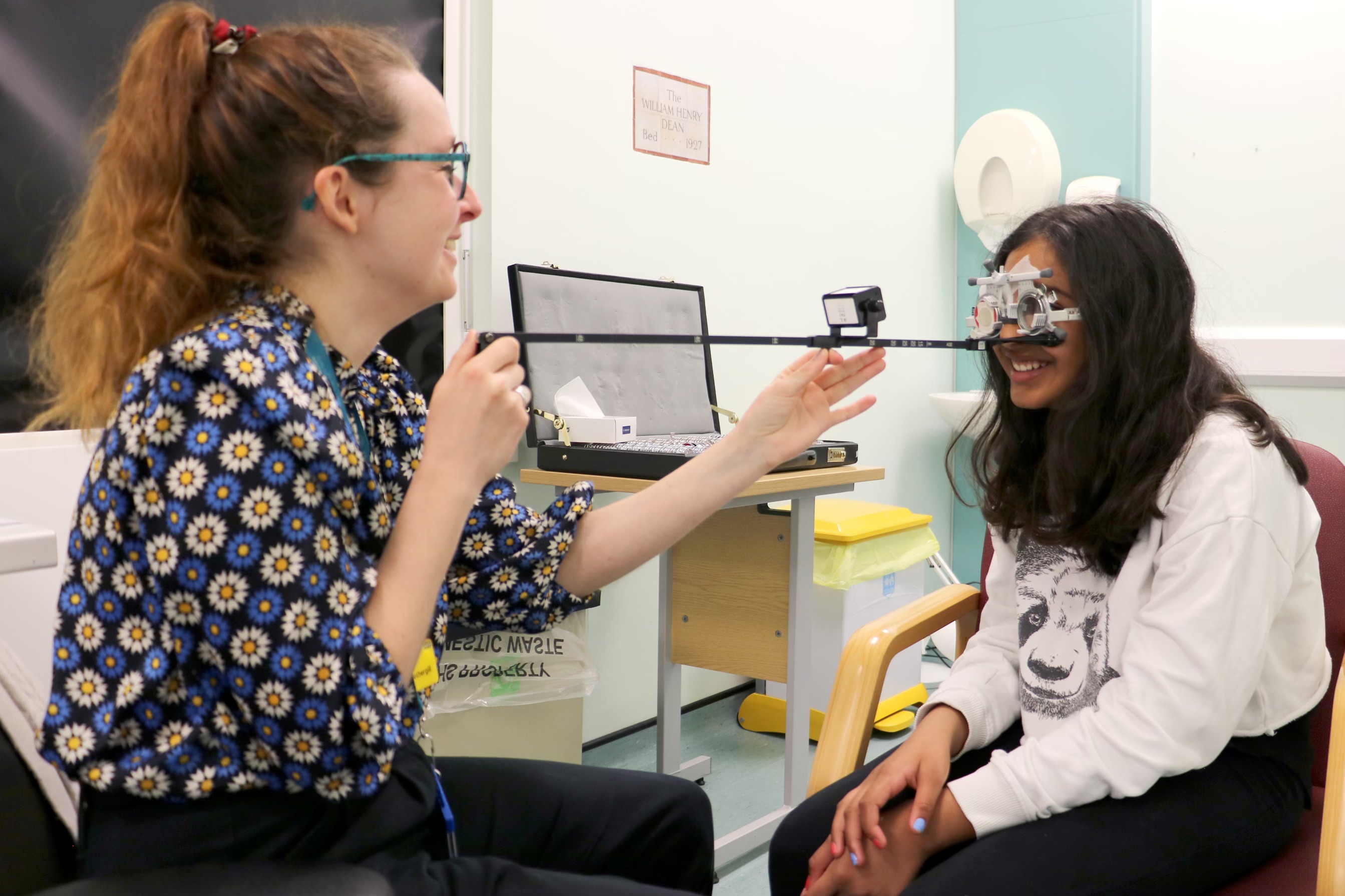 Example of a child reading letters on the ruler
Autorefraction
Why do we do this? This is a quick way to measure your refractive error (what glasses you wear), and sometimes we also measure your pupil size. This is an automated machine and will tell us how your eyes bend the light to help you to see. We can also see how much your pupil adapts to the light and to focus on objects near and far.
What do you do? Like all our tests your eyes need to be still as possible, so we will ask you to rest your chin on the chin rest and your forehead against the headrest and keep looking at the RED BALLOON. You have to hold your gaze for 5 seconds.
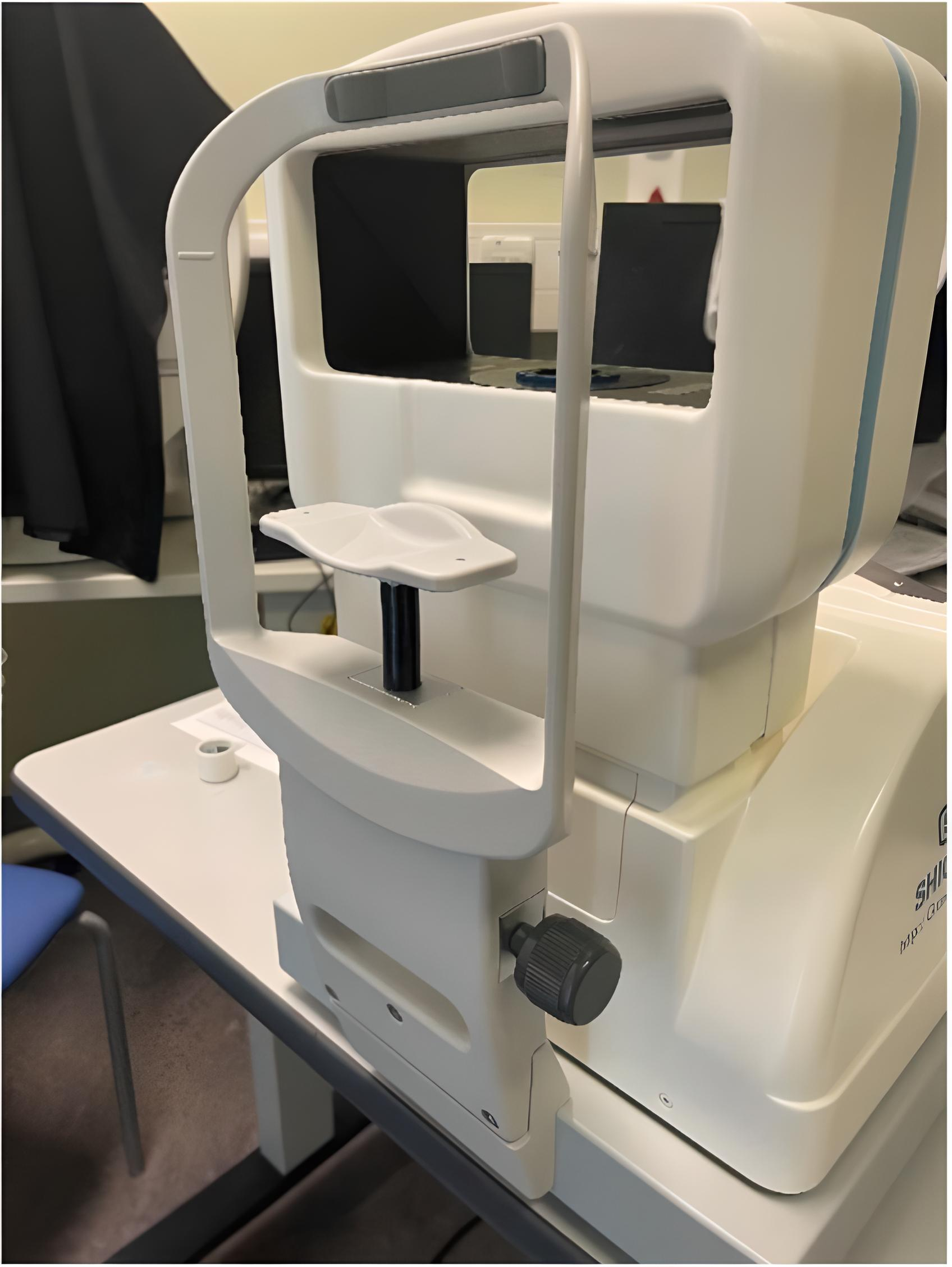
Grand Seiko machine for autorefraction – view of where you rest your chin
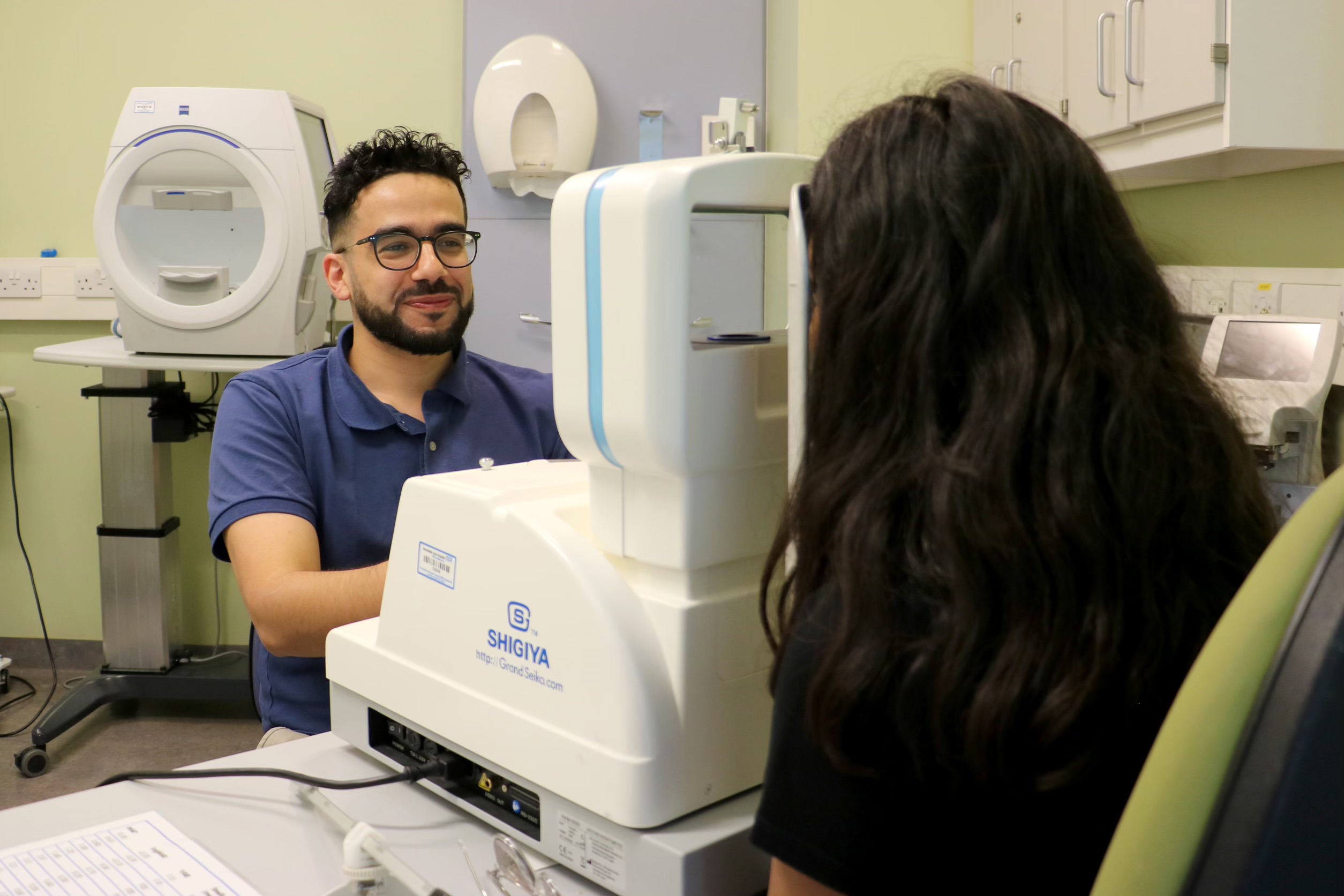 Example of a child with their chin on the Grand Seiko machine chin rest
How will it feel? Refreshingly, this is a test without bright lights. You only need to keep your eyes still for 5 seconds and the test is done. You won’t feel any different than if you were looking at a picture.
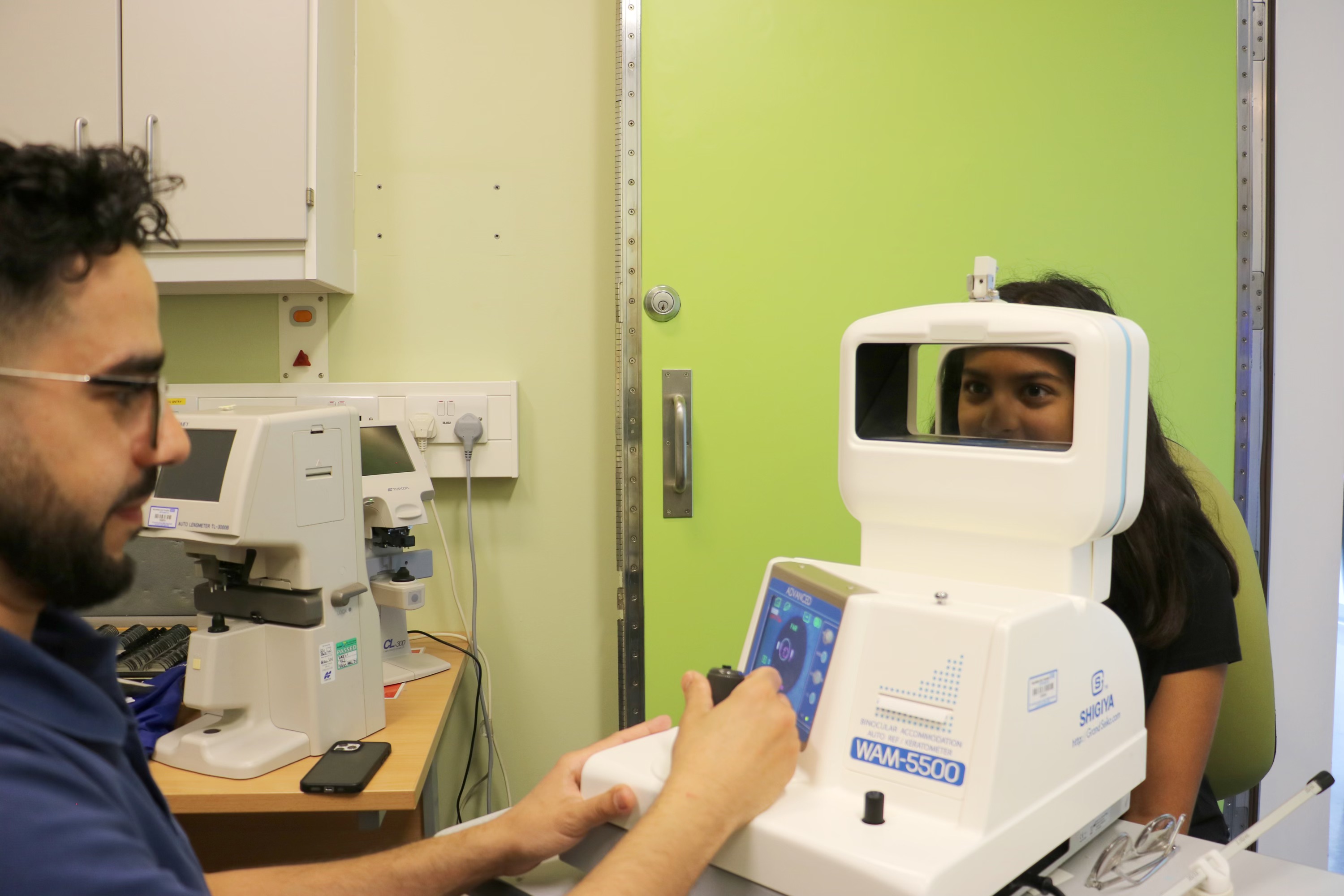 Example of a child using autorefractor machine Grand Seiko
Axial length
Why do we do this? This is the measurement of the length of your eyes. Eyes need to be a certain length so that when they bend light, you can see. If the length is too long or too short you need correction (glasses) to help you see. We measure the Axial Length to see if there are any changes to the length over time / course of treatment.
What do you do? You will be asked to rest your chin on the chin-rest and your forehead against the headrest and look at the red light. This one will have a quick green flash and is quick! But the machine (IOL master) is very sensitive so you need to keep as still as possible.
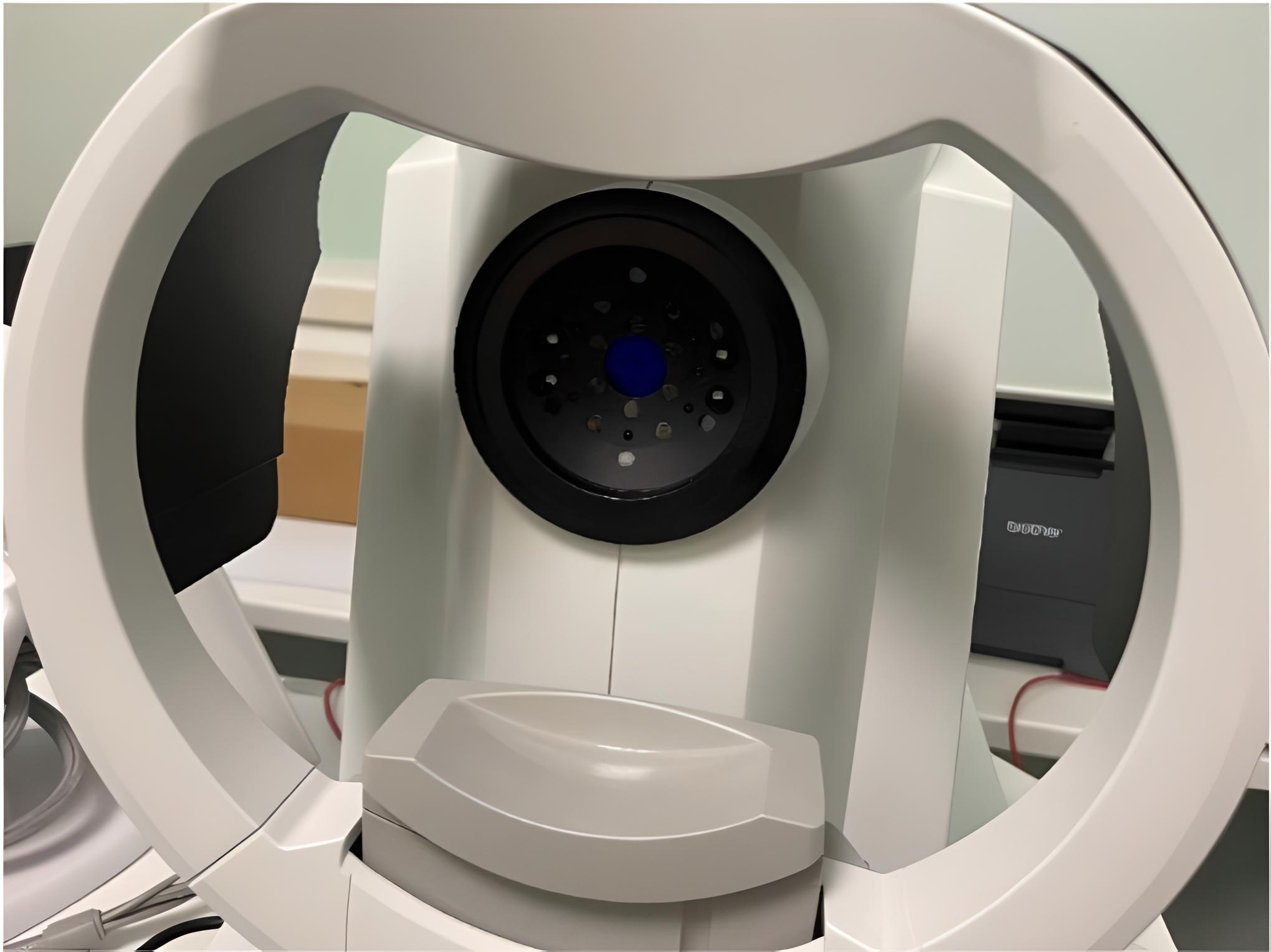
IOL Master machine - view of where you rest your chin
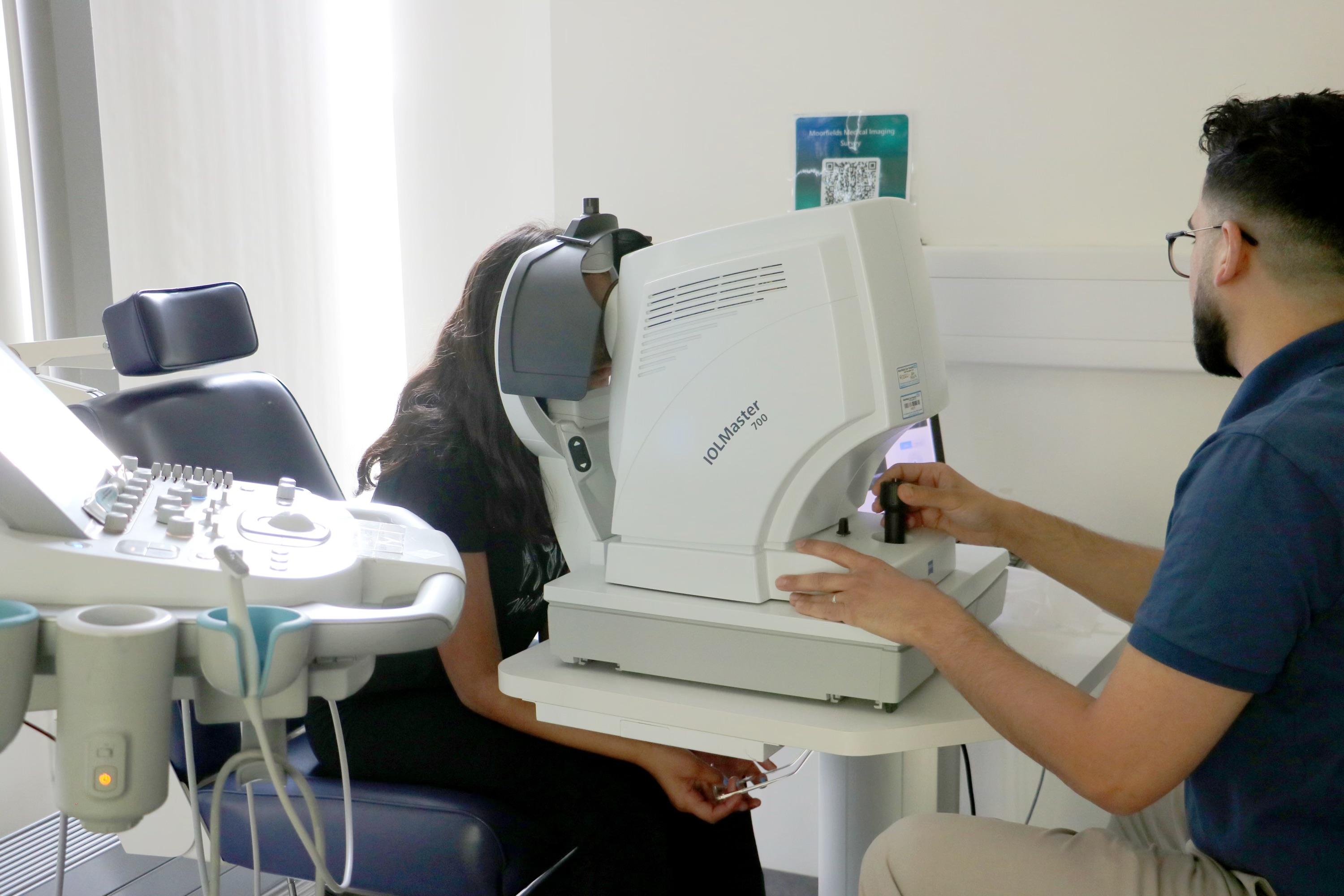 Child with chin in chin-rest of IOL Master machine
How will it feel? You might be a bit sensitive to the green flash and might want to blink right after. Blinking is fine, but try really hard to stay still on the headrest - try not to jump back!
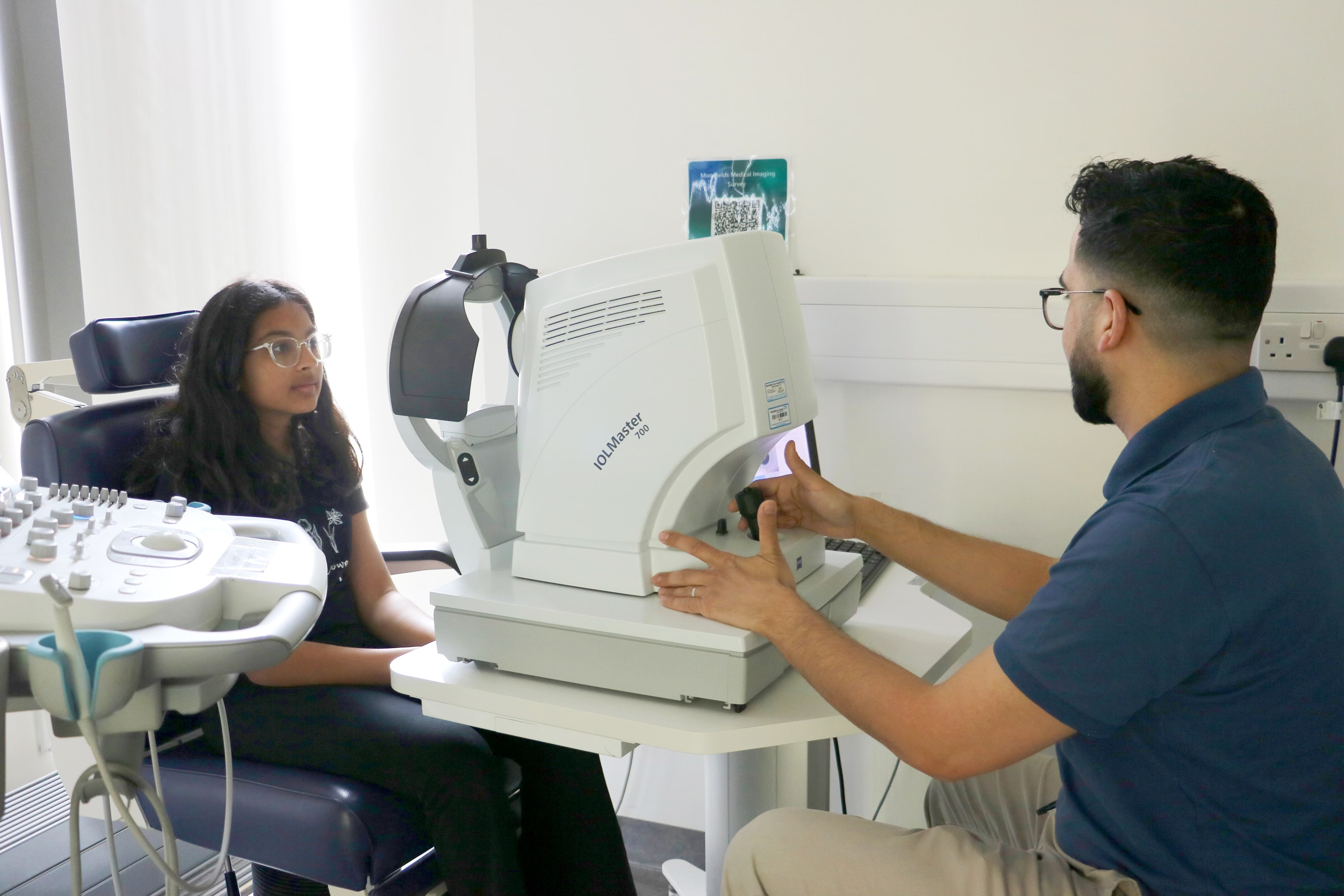
Child preparing to have Axial Length measured with IOL Master 700 machine
B
Best Corrected Visual Acuity (BCVA)
Why do we do this? This test is for us to measure the smallest possible letters that you can see.
What do you do? We will ask you to read a chart of letters (or pictures) with each eye in turn. The letters on the chart get smaller and smaller as you read.
How will it feel? We will always ask you to guess on the difficult ones, even if they are blurry or very small. Don't worry if you get the letters wrong just have your best possible go.
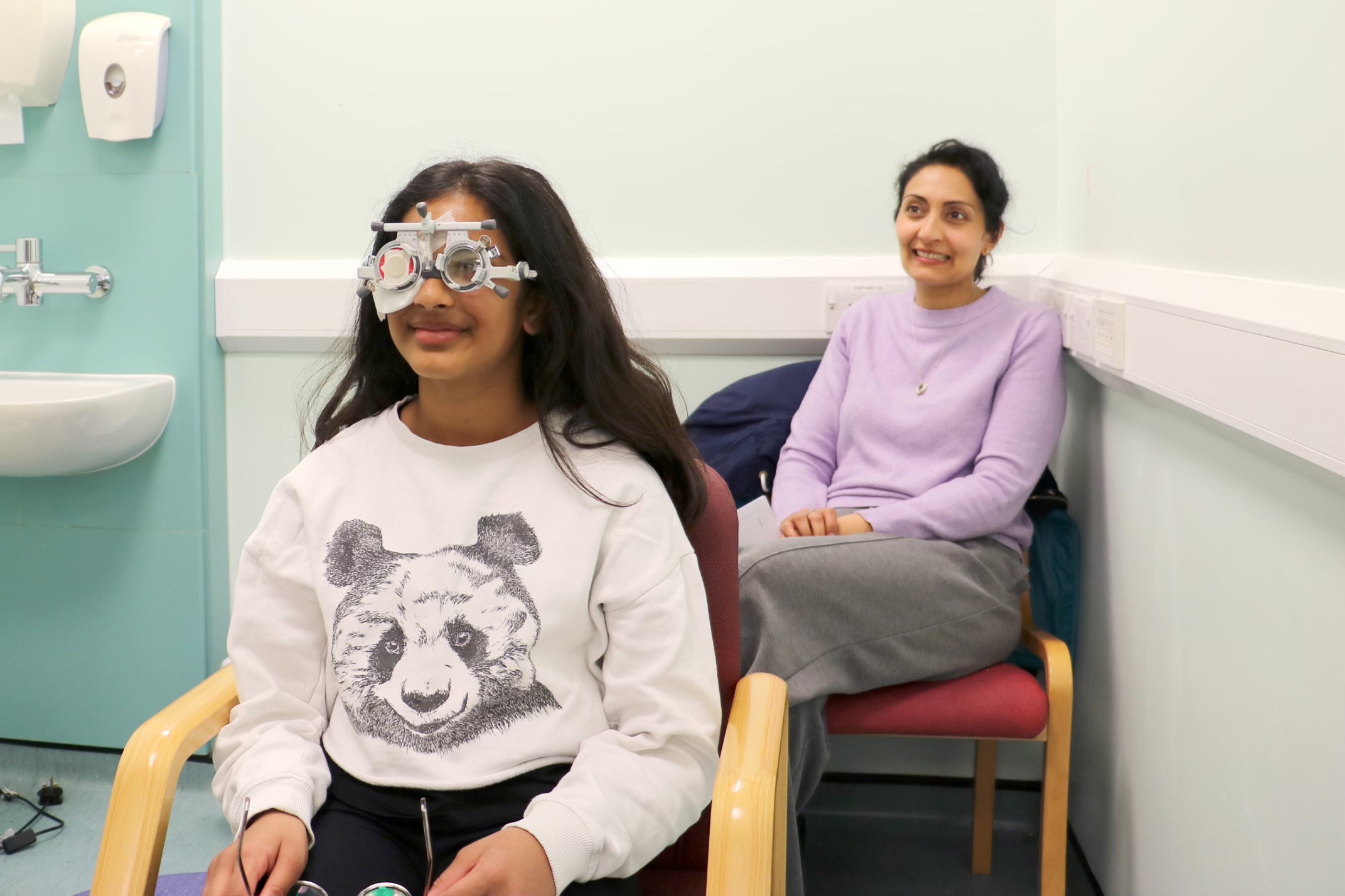
Child with special ‘trial’ glasses frames on for BCVA, parent sat behind.
Blood pressure
Why we do this? We measure your blood pressure to see how well your heart is pumping. We can check if your blood pressure is normal for your age.
What do you do? You need to sit and be as relaxed as possible in your chair. We will need you to take your jumper off or top layer of clothing on your arm. We will wrap a cuff around the top of your arm (see the picture), and it will blow up a bit like an arm band when you go swimming. Try and breath normally and relax. It won't take more than a couple of minutes. The blood pressure machine attached to the cuff will automatically measure your blood pressure and display the result in numbers.
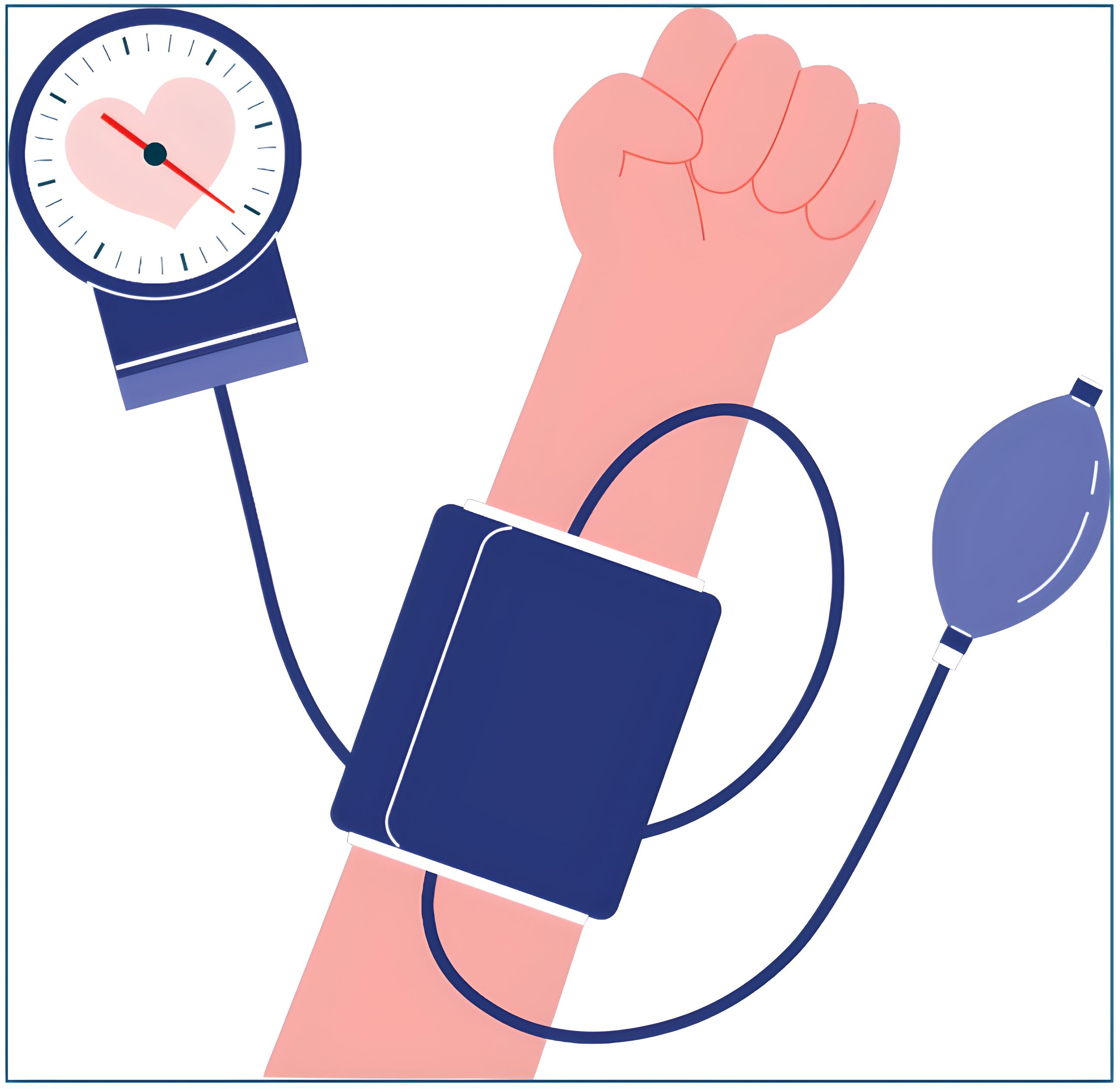
How will it feel? When the cuff around your arm blows up, it doesn't hurt but it can feel quite tight as it blows up and up. Then you will feel the machine release and the air will come out and the cuff will slowly loosen. This may feel funny the first time you have it done, but you will soon realise it is nothing to be scared of.
Blood tests
Why do we do this? There can be lots of reasons for blood tests in research. For example, researchers may want to check how your body is responding to the treatment you are taking. Blood samples can give researchers lots of information about your health.
What do you do? You can have your parent or support person with you to make you feel more comfortable. You can also ask for a Health PlaySpecialist to support you during the blood test. They could talk through what will happen, offer a stress ball or a hand to hold, for example.
Sometimes you have to not eat or drink anything (other than water) before your blood test. It will help the nurses with the blood test if you have drunk lots of water. A strap (a bit like a tight belt) will be put around your arm (called a tourniquet). This also helps the nurse take the blood sample. The nurse will use a very small needle to take some blood from either your arm, or sometimes the back of your hand, for example. They will collect the blood in small tubes and send it to a laboratory for testing. After the test, the nurse will put some cotton wool or a plaster to cover where the needle has been. You may get a small bruise or some swelling, but this shouldn't last long. If you feel more comfortable you can lie down when the nurse performs the blood test. Try and stay as still as possible.
How will it feel? Sometimes the strap around your arm (the tourniquet) can feel very tight and a bit pinchy. You may feel a sharp scratch which can be uncomfortable for a few seconds. We can use some cream or cold spray to help make the area where we take the blood from feel numb.
C
Colour Fundus Photography (Optos machine)
Why do we do this? Here we take a picture of the whole back of the eye – here is an example of what the picture looks like:
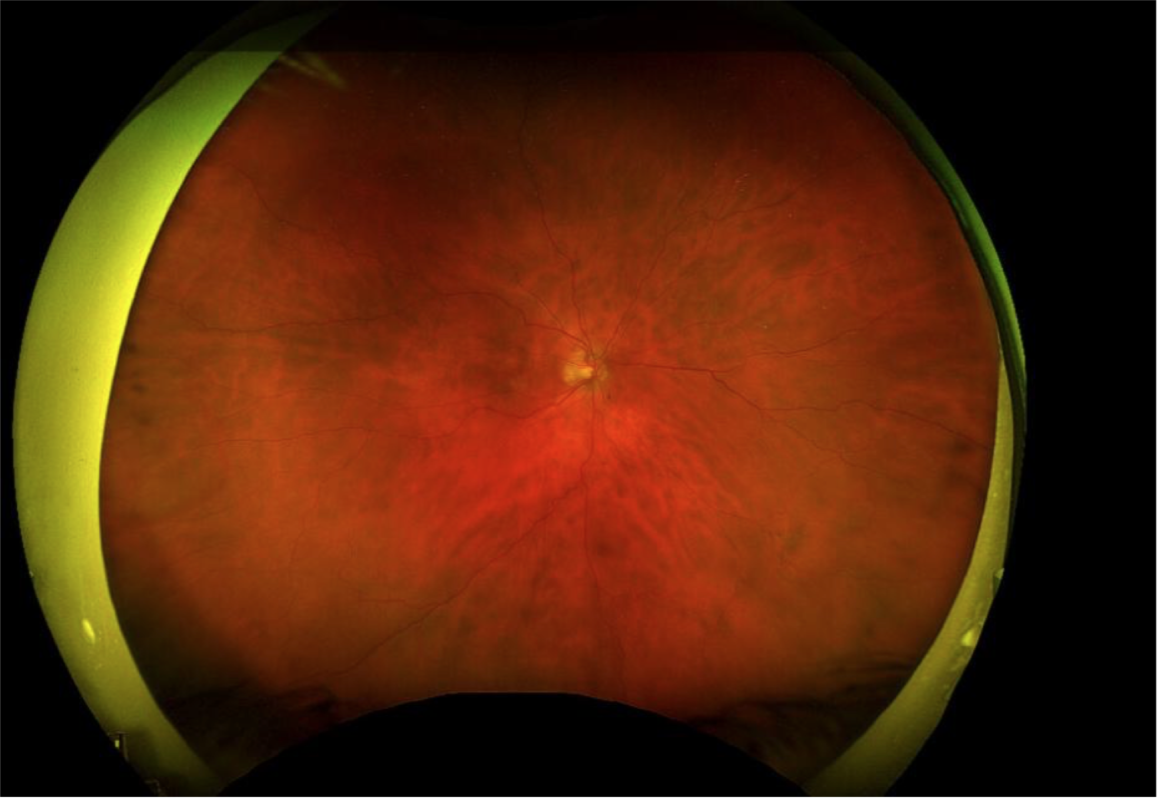
Example Fundus image
What do you do? To do this test, we will pretend that you are looking into the peephole of a door - so your head is facing away from the device and your eyes are looking into it.
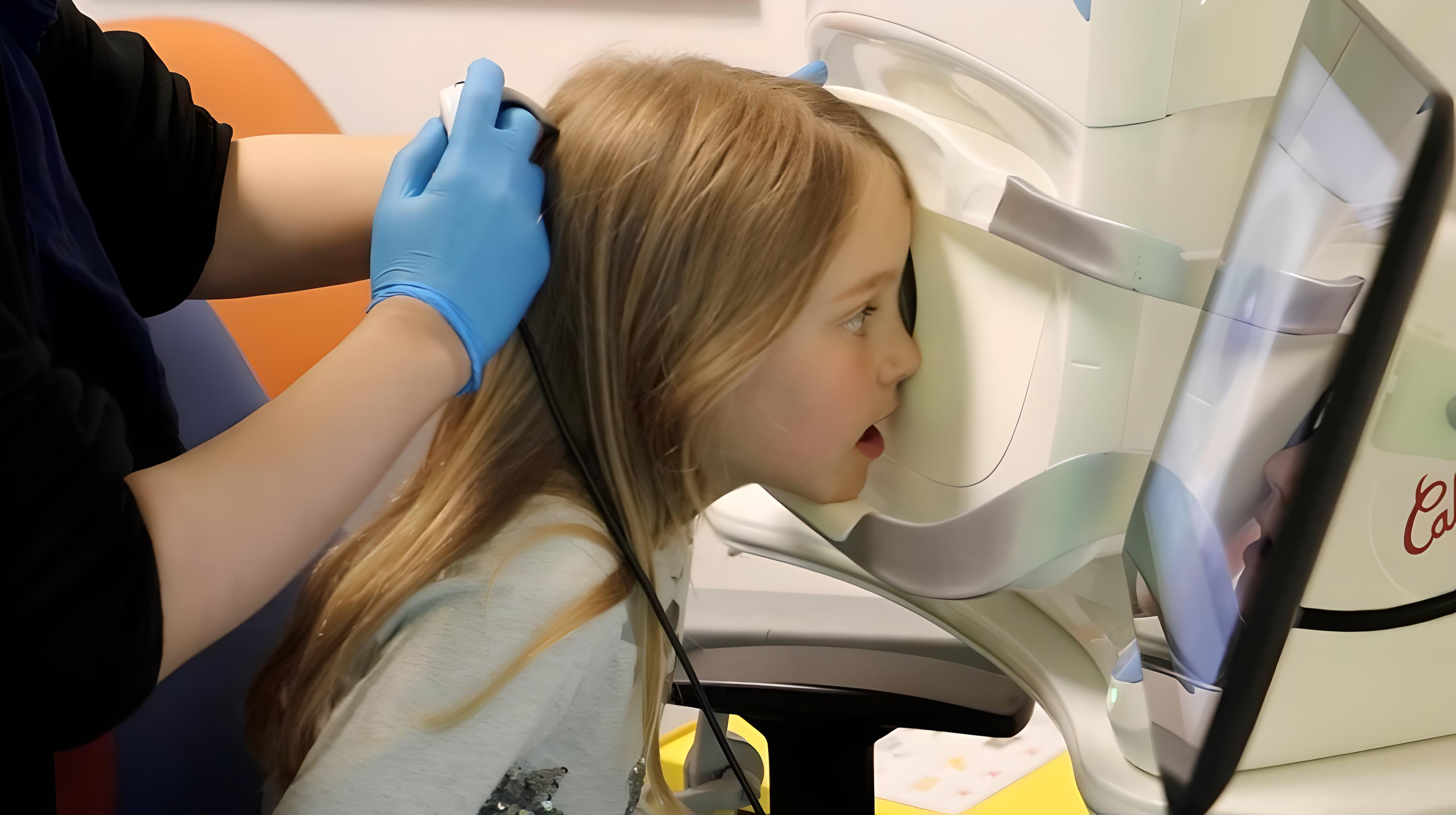
Example of child with chin on chinrest of Optos machine
You will see a BLUE light which will turn GREEN - Keep your eyes wide open and we will take the picture.
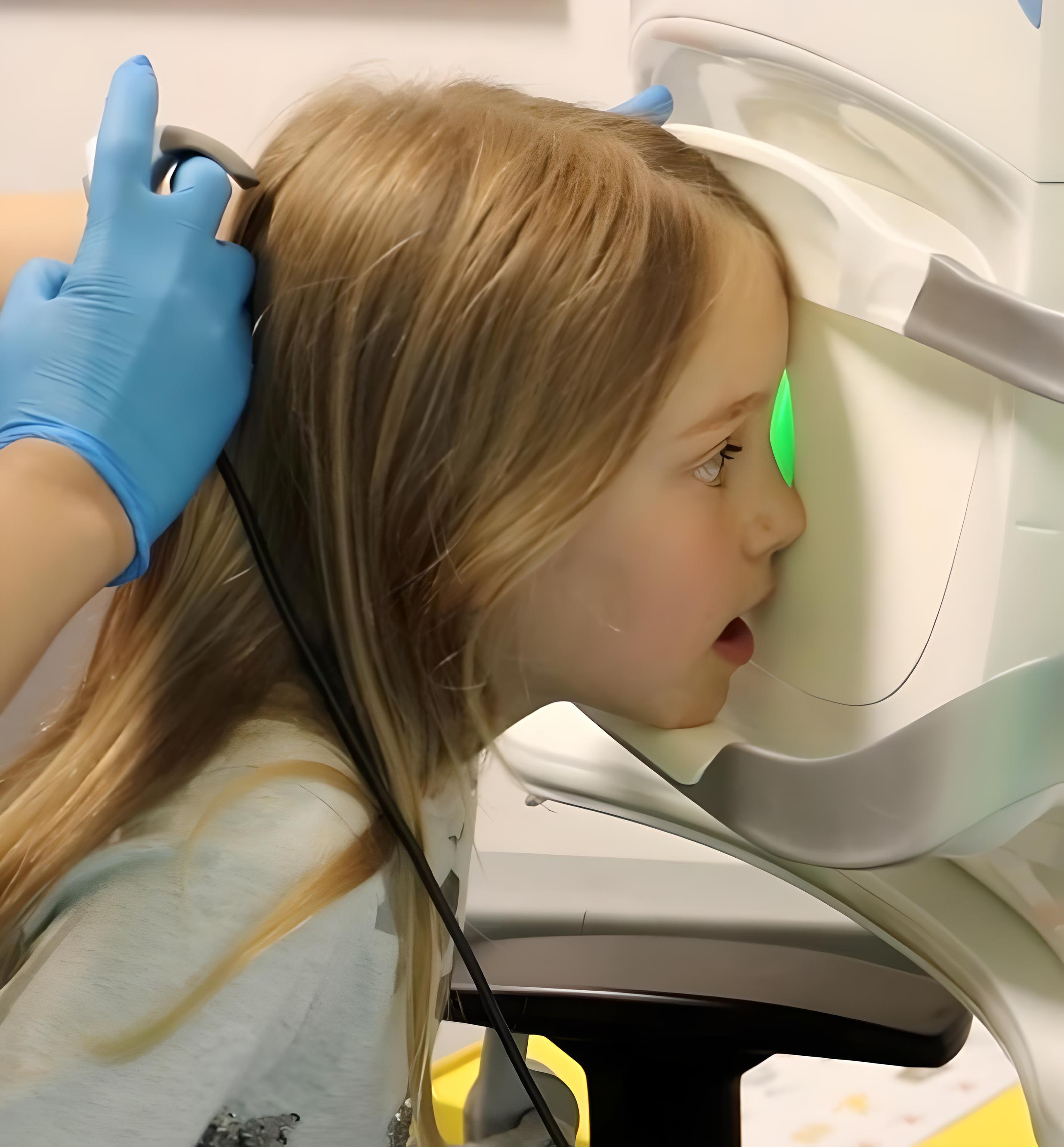 How will it feel? It is not painful but remember, there will be a flash when we take the picture! It might be bright but let us know if it is really really bright - we can always stop.
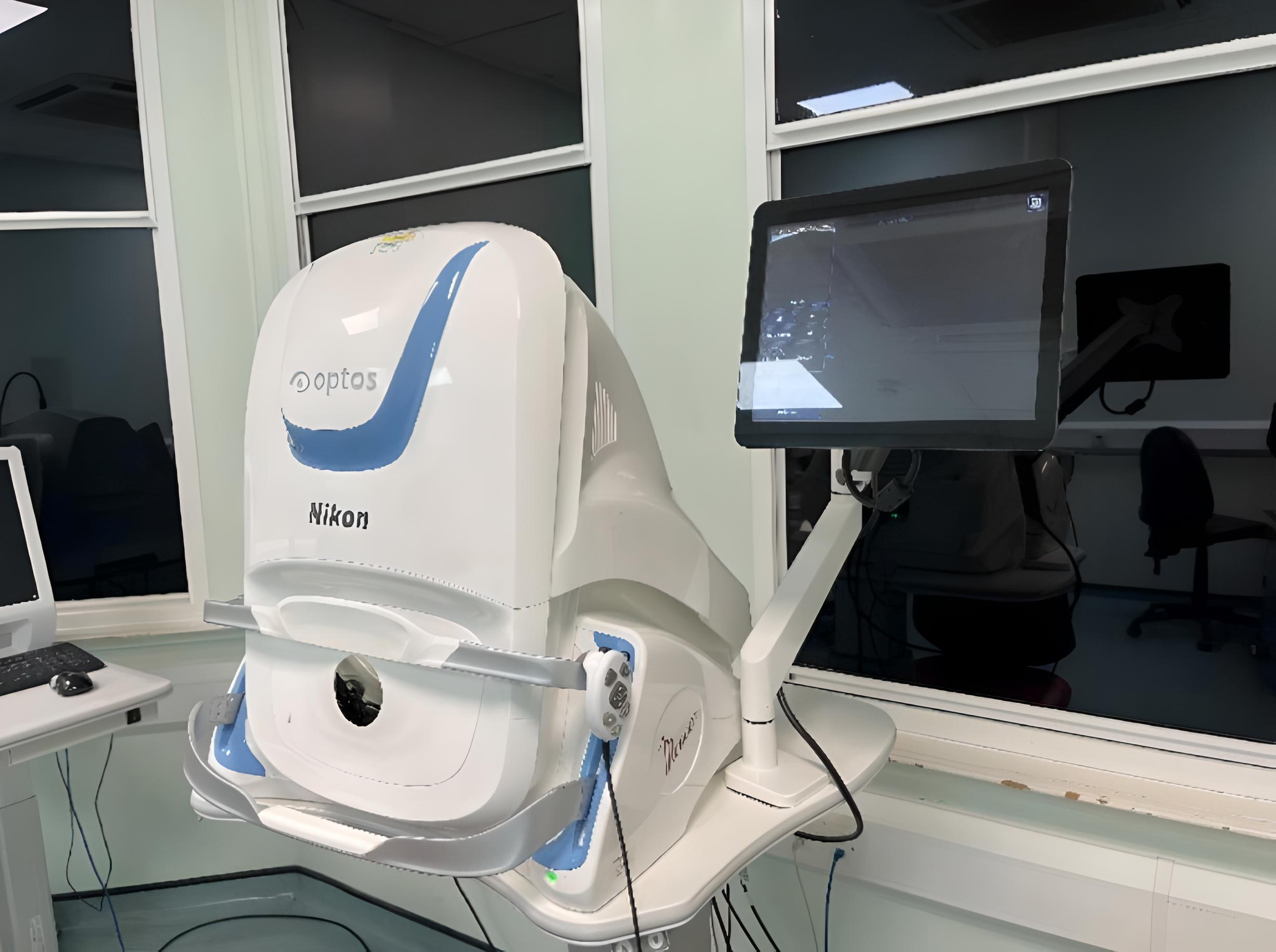 Optos machine
Concomitant medications
Why we do this? While you are taking part in research, we need to keep track of any medicines you are taking alongside your research treatment (concomitant medications). Sometimes there are some medicines you shouldn't take together so we need to check this. Also, we need to monitor if other medicines have an effect on your research treatment.
What do you do? A bit like the ‘adverse events’, we need to write down what concomitant medications you have taken since your last visit. So you and your parent/carer need to write down the names of medicines you take, and extra details like why you took the medicine, when you took it and how much.
How will it feel? This will just be asking you and your parent/carer questions. It may feel a bit like a memory test!
Contrast sensitivity
Why do we do this? We do this test to get an idea of how well you can see in different lighting conditions.
What do you do? For this test we will show you letters that are all the same size but they get fainter/ lighter in colour each time.
How will it feel? Sometimes when the letters get very faint it can feel like you are looking at a blank page. Often if you turn your head side to side or stare at the letters for a few seconds they become easier to see. We will ask you to have a go at the very faint letters even though they are difficult. Don't worry if you get any wrong, just have your best possible guess.
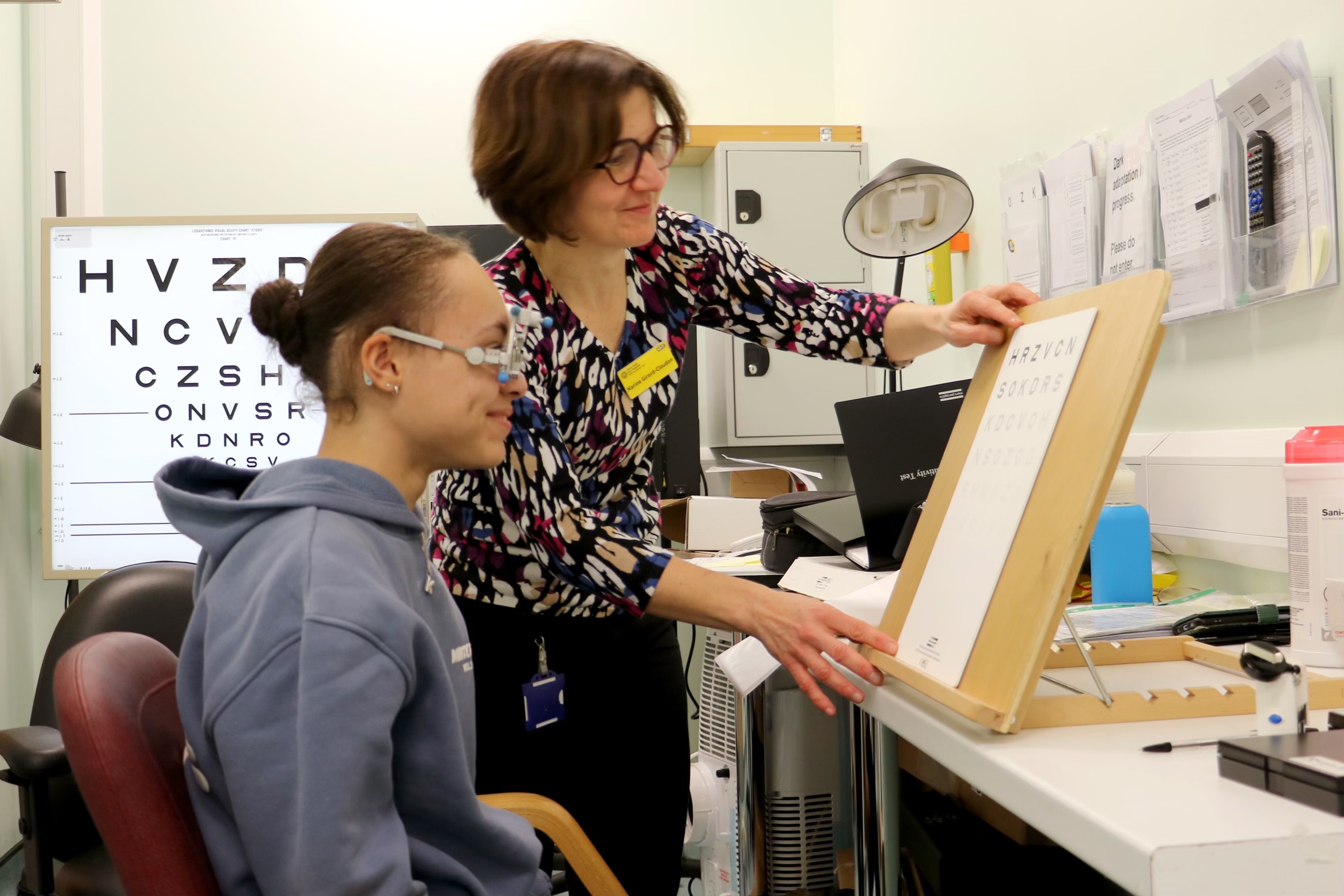 Example of a young person completing contrast sensitivity test
D
Dark adaptometry (AdaptDx)
Why do we do this? This is an interesting test that allows us to measure how quickly your eyes adapt form light to dark. Lots of changes in the eyes can be detected by this method, that you otherwise won’t notice day to day. It is a very good way to check your eye health.
What do you do? This test will begin after 30 mins in the dark, we keep you in the dark, by covering your eyes with a cotton patch, so that your cone cells are completely switched off. After the 30mins, we will put you on the device (all in the dark) and you will place your chin on the chin rest and head against the head rest. We will uncover 1 eye and ask you to focus on the red light. The test will begin after a bight flash - similar to a camera flash - and you will be asked to click a button when you notice something flash.
How will it feel? This test will feel long, because we keep you in the dark for so long. You can use your headphones to listen to books or music if you want. When the bright flash happens it might take a while for your eyes to adjust and you might get bored for this part - try to keep going!
Diary review
Why do we do this? If you have been asked to complete diaries, we will ask to see them when you come for your visit. Sometimes your diary might be for how often you take your treatment, or how often you do other activities. It is important you complete these as well as possible and remember to bring them back so we can review them with you at your research visits.
What do you do? We may keep the diaries or discuss what is written in the diaries or make some notes and give them back to you to keep using.
How does it feel? Reviewing the diaries together is important so we can understand more about what happens in-between research visits. Nobody is judging what you have written. Be open and honest with us so we collect real information about what it is like for you.
Dilated slit lamp biomicroscopy
Why do we do this? A slit lamp is a special machine that shines a bright light and lets the eye doctor see different parts of the eye in more detail. Imagine a magnifying glass that helps a doctor see inside your eye. Now your pupils are bigger from the dilating drops, we can see through to check the back of your eye (fundus).
What do you do? You sit in a chair and rest your chin on a ledge. The doctor will bring the machine closer to your face, shine a light into your eye and use lenses to see different parts of your eye. You will be asked to look in lots of different directions, up, down, left, right for example.
How will it feel? It can be very difficult to have the light shine straight in your eye, but you are allowed to blink, which can help.
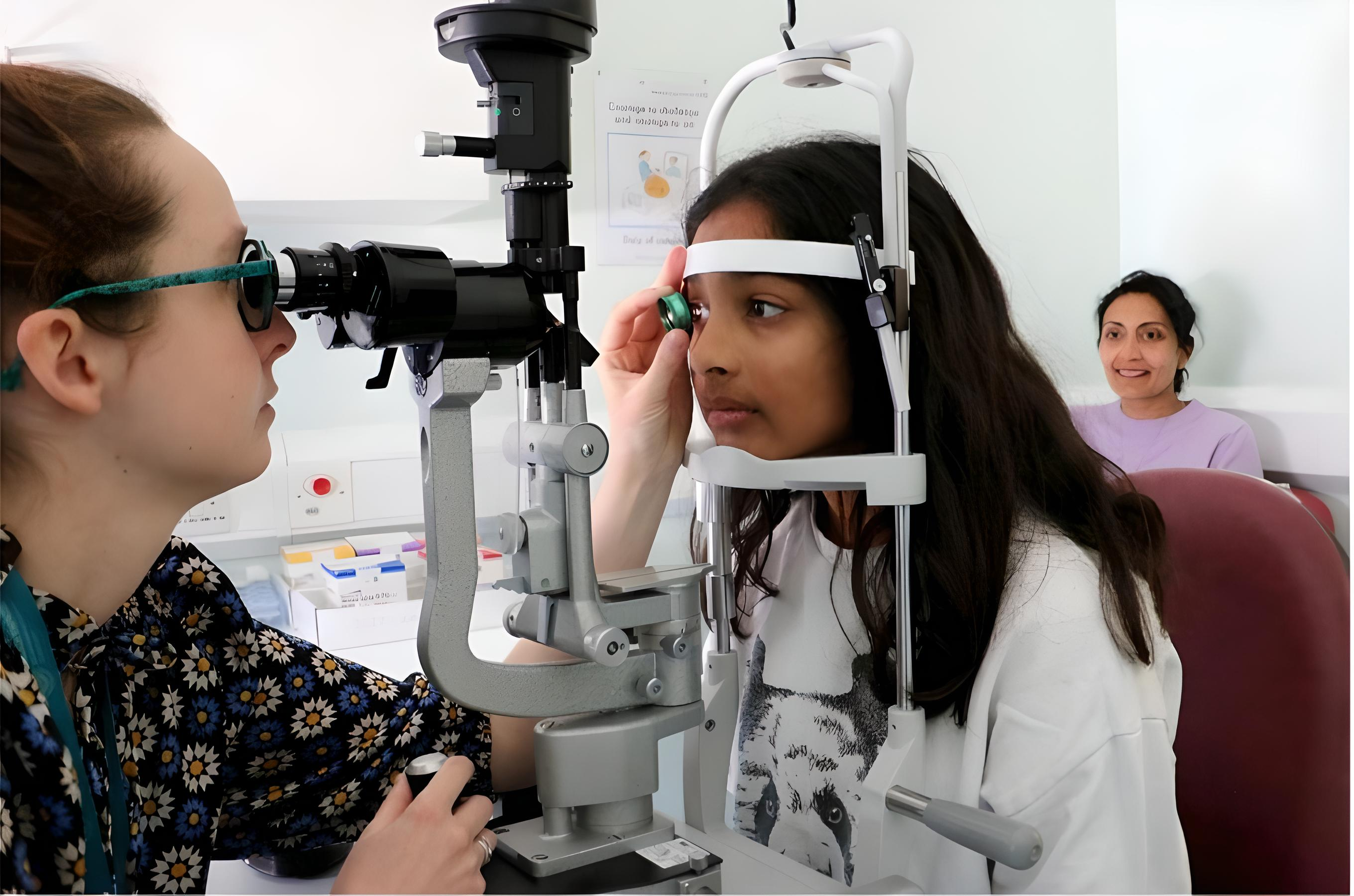 Slit lamp machine with clinician using a small VOLK lens to look at back of eye
Sometimes the clinician may use a special headset to complete the same assessment, like this:
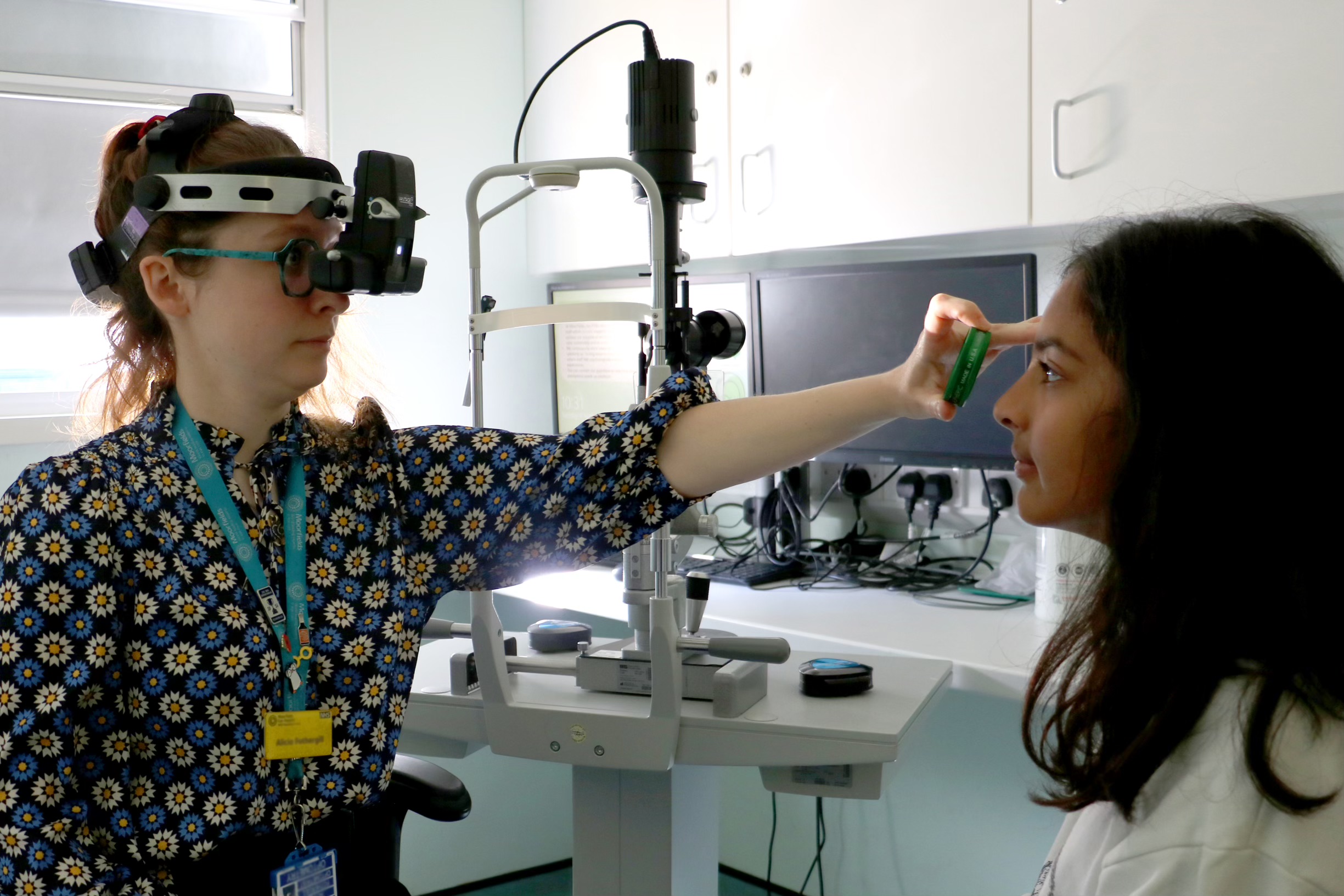 Headset indirect opthalmoscopy using large lens to look at back of eye
Dilating eye drops
Why do we do this? We use these special eye drops to help us see the back of the eye better.
What do you do? You tip your head back and the researcher will drop a small amount of liquid (it looks like water) into your eyes. You can sit in a chair or lie down. These drops make your pupils — the black circles in the middle of your eyes — get really big.
How will it feel? The eye drops can be stingy for about 5 seconds, then watery for another 5 seconds and then your eyes usually feel ok again. The drops take about 20-30 mins to work and can make everything a bit blurry for about four hours (sometimes more or less than four hours). Your eyes can feel sensitive in bright lights, so bringing sunglasses or a hat can be useful for the journey home. Lots of children have these drops put in at the eye hospital. Try not to worry - but if you are worried - tell us and we can support you.
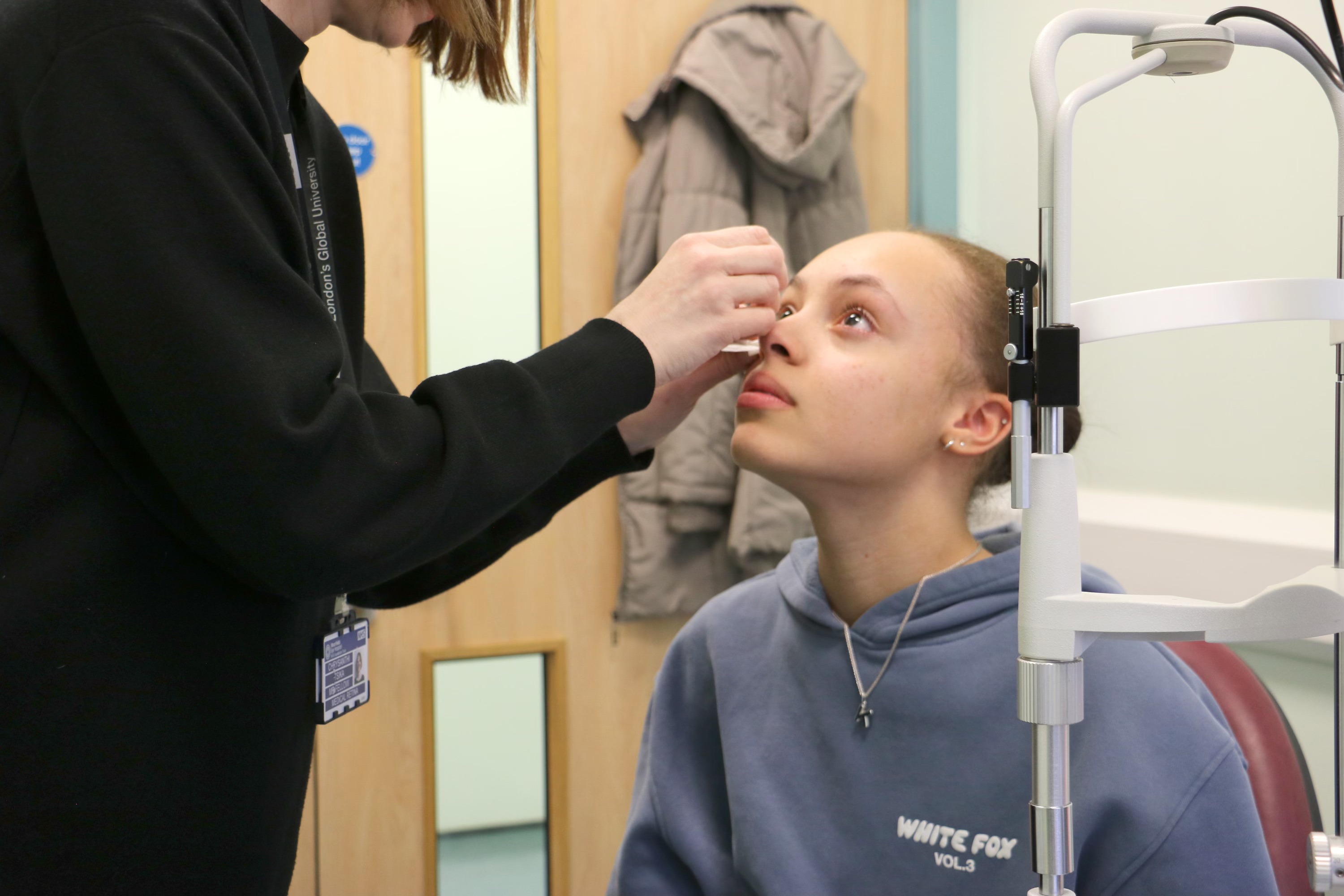 Eye drops being instilled with a young person sitting up
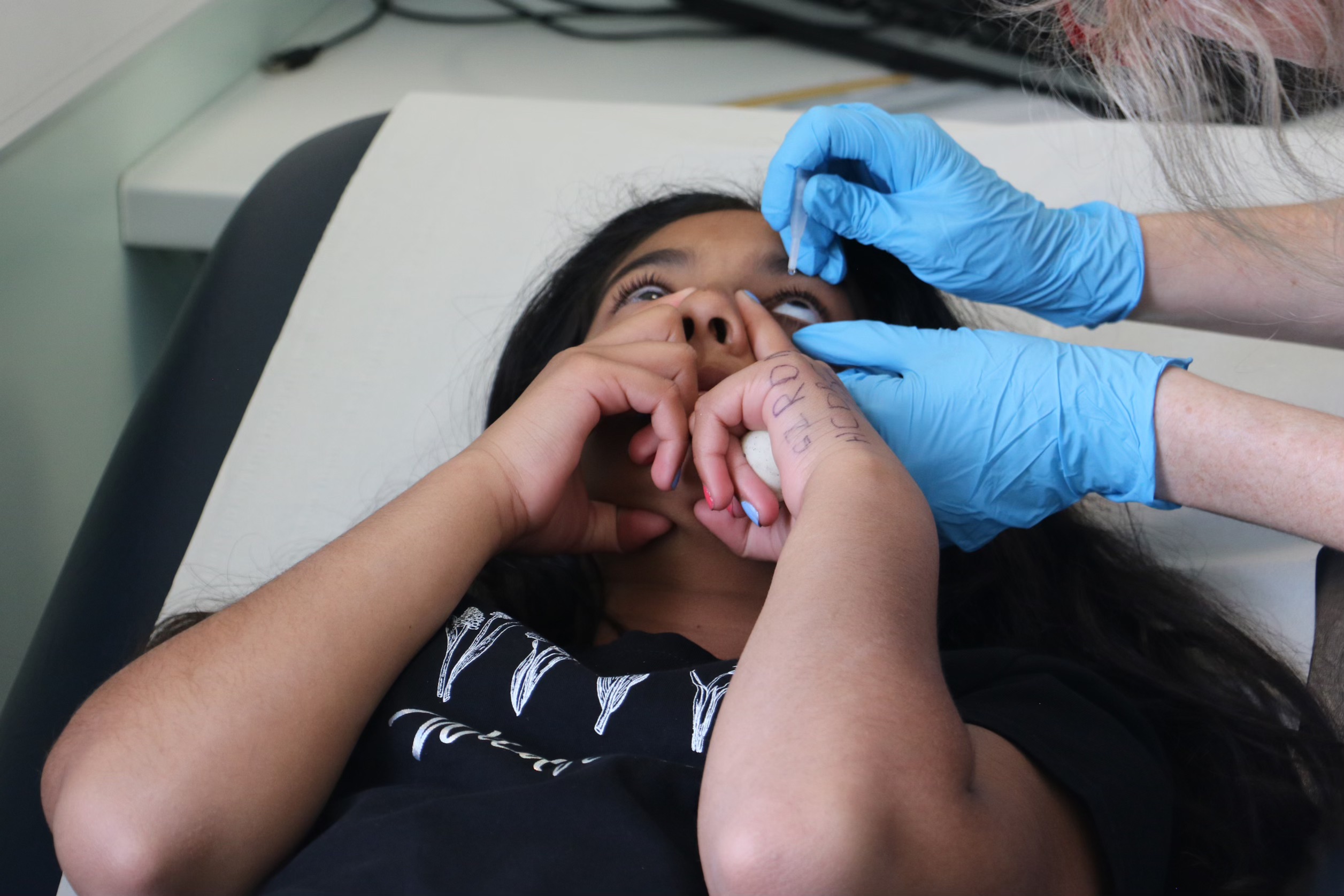 Eye drops being instilled in a child lying down
E
ECG (Electrocardiogram)
Why we do this? An ECG shows us a picture of the rhythm of your heart (the electrical activity) and tells us how fast your heart is beating. One of the doctors will look at the ECG picture to see if your heart activity looks healthy.
What do you do? You lie down on the bed and will have sticky dots (electrodes) attached to either your shoulders or wrists, your hip bones, or maybe your ankle bones - different research studies ask for different sticker positions. You will also have stickers attached to your chest, around where your heart is. To do this you will need to take your top off. It is best not to wear any jewellery or metal or have any wires in your underwear. We can give you a sheet to cover you up. The nurse will attach leads to the stickers (electrodes) which connect to the ECG machine - the leads are quite long and can get in a muddle! No electricity goes into your body. When everything is in place, the nurse will tell you that the recording is starting and you just have to lie as still as possible. Think of a calm and nice setting! This whole process takes around 10-15 minutes. The Health Play Specialist can help you to relax during the ECG if you would like.
What do you feel? This doesn't hurt. It can be a bit embarrassing to have the stickers put on you. Don't worry the nurses do this all the time and are very professional. We can make sure you are comfortable and you can have your parent or carer with you, or a member of staff as a chaperone with you if you would like. Tell us if you have any concerns or want to discuss who does your ECG for you and who is with you.
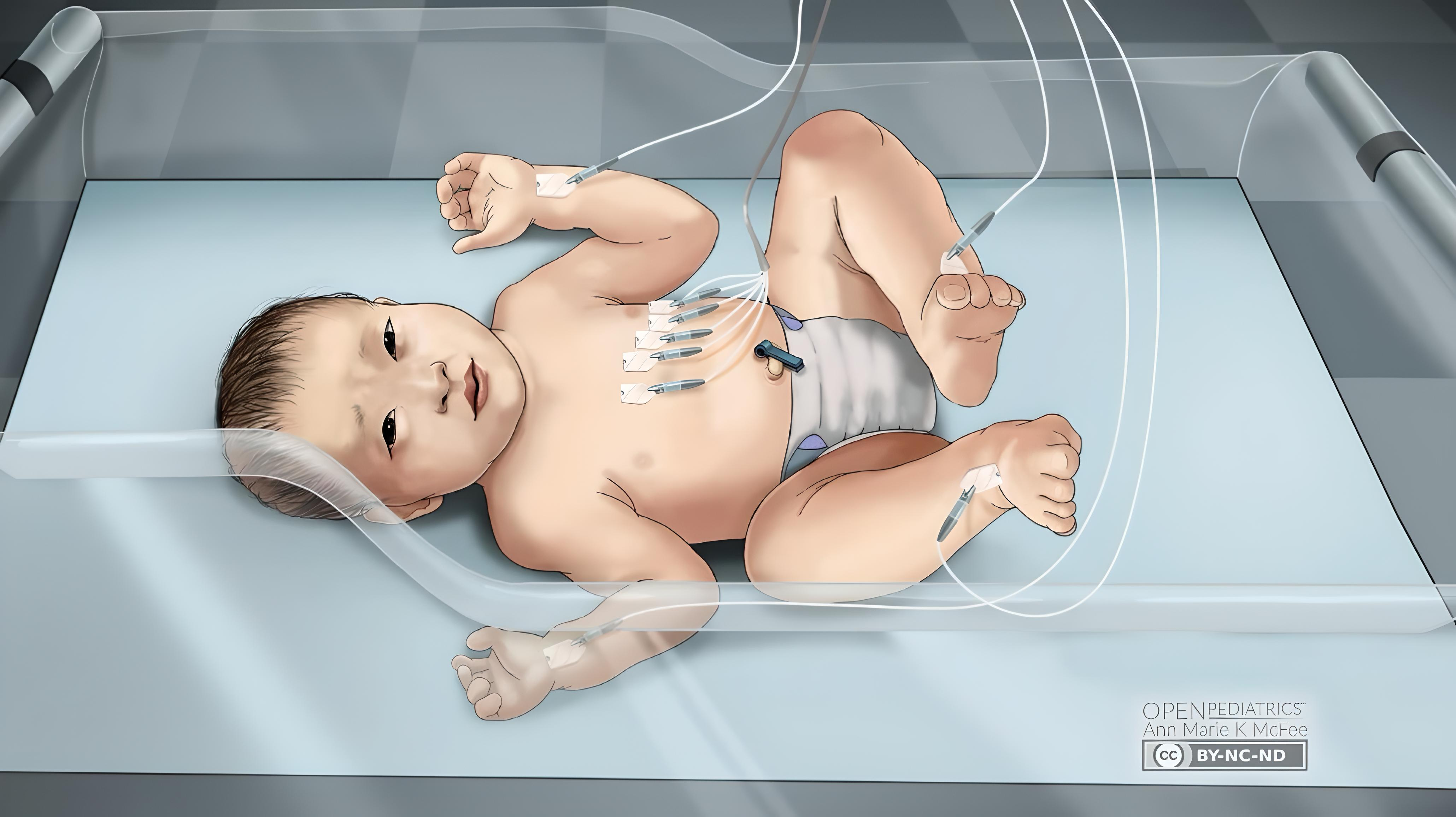 Example of ECG leads placement
Image from:OPENPediatrics
Eligibility assessment (inclusion / exclusion criteria review)
Why do we do this? Usually in research there is a list of inclusion and exclusion criteria. This is so that the people involved in the research are the most appropriate people to help answer a research question. To be included, you might need to, for example, be a certain age, or have a certain eye condition, or your eye condition might need to be at a certain stage.
What do you do? Sometimes you may need to come for your first visit (called a screening visit) and do some assessments and answer some questions which will help us think through whether the inclusion criteria are met, for you, for this research question, and importantly - whether you want to take part. The researchers may know straight away on the day and let you know if you are eligible (you meet the inclusion criteria and none of the exclusion criteria), or they may need to study the results of the tests and let you know on another day.
How will it feel? It may feel a bit funny not knowing whether you will be included in the research or not, even after sometimes doing a whole day of testing. You may feel happy or sad if you are included or not included. It may feel a bit mean to not be included (excluded) but remember, this is because we need to be very strict about whose eyes are included, so we can answer the research question. Keep a look out for more research you could get involved with.
Fundus autofluorescence (FAF)
Why do we do this? This test helps us take special pictures of the back of your eye, to make sure it is healthy, particularly a layer of cells called the retinal pigment epithelium (RPE). Natural substances in the eye (such as lipofuscin) are highlighted in these pictures. It helps the eye doctor see how well your eye is working and helps us look for any problems early.
What do you do? You will sit in front of the camera and rest your chin on the chinrest and forehead on headrest to keep your head still. You look at a BLUE CROSS while the camera takes images of the back of your eye. The test uses a special light to capture autofluorescence images. The procedure is quick and usually takes only a few minutes per eye.
How will it feel? The test is painless. Brief flashes of light will be shined into your eyes, which can be bright but are not harmful. You might see some temporary after-images or for a short time afterward, you might see everything in Pink!
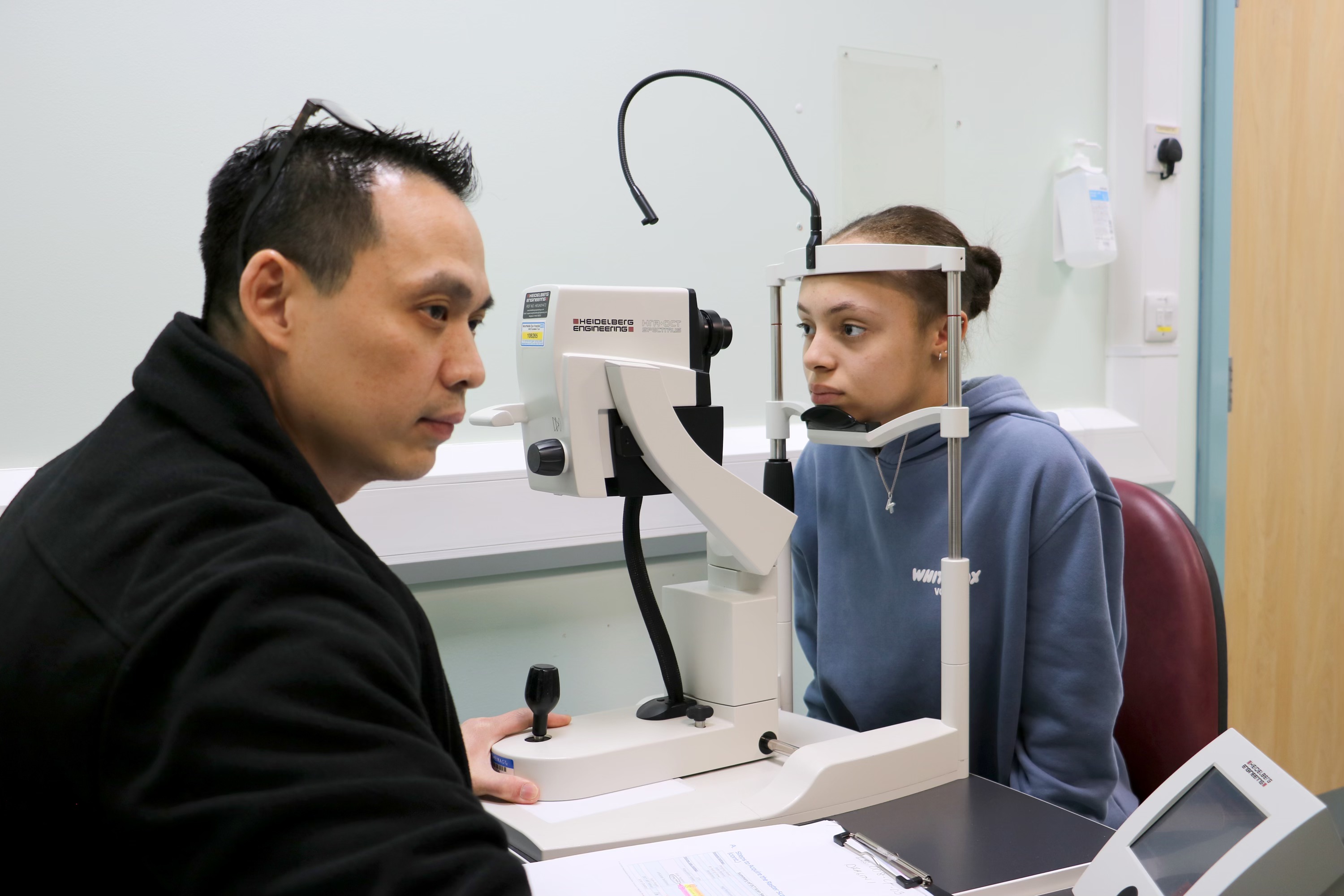 Example of child and clinician using Spectralis machine for Fundus autofluorescence
H
Health play specialist
A health play specialist works with children and young people of all ages to help reduce stress, anxiety and worries. They can help prepare you for tests or procedures. They have games or arts / crafts you can play with while you are waiting. They have fidget / sensory toys if these could help you feel relaxed during testing or waiting. They can talk through your worries if this is helpful. They can help make your visit manageable and fun!
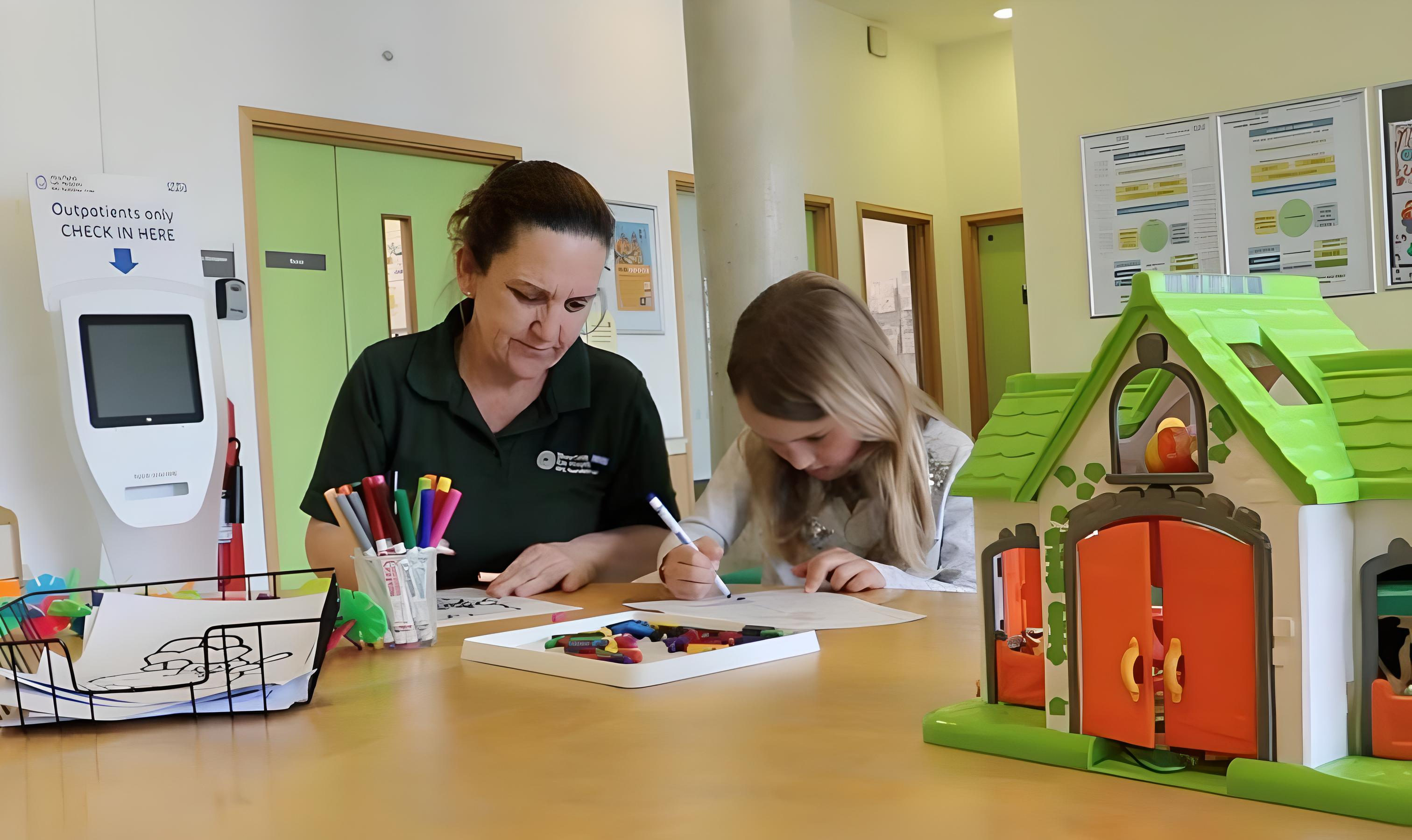 Example of health play specialist supporting a colouring activity
Heart rate
Why do we do this? For some studies we need to check if your heart is beating at a normal rate for your age.
What do you do? To do this test, we will either feel your heartbeat (pulse) on your wrist with our fingers. We can feel your heart beating here. We will count how many times it beats in a minute. Or we may use a machine to count for us. For this we usually use the oxygen saturation monitor which has a soft clip which we attach to your finger. This machine tells us your oxygen levels flowing around your blood and your heart rate.
How will it feel? This is not painful. Either you will feel us holding your wrist or have a soft cushion clip on your finger. If we use that machine it is really important to hold your hand still. We will usually take a couple of minutes to take this reading to make sure we have it correct.
Height
Why do we do this? In research we usually measure children's height so the researchers can see if treatments make a difference to how tall you are growing.
What do you do? We will ask you to stand up without your shoes on and measure how tall you are with a long ruler (which is usually attached to the wall). The top of the ruler will rest on your head. We will ask you to take off any hats or hair bands which may get in the way.
How will it feel? You will feel the ruler resting on your head.
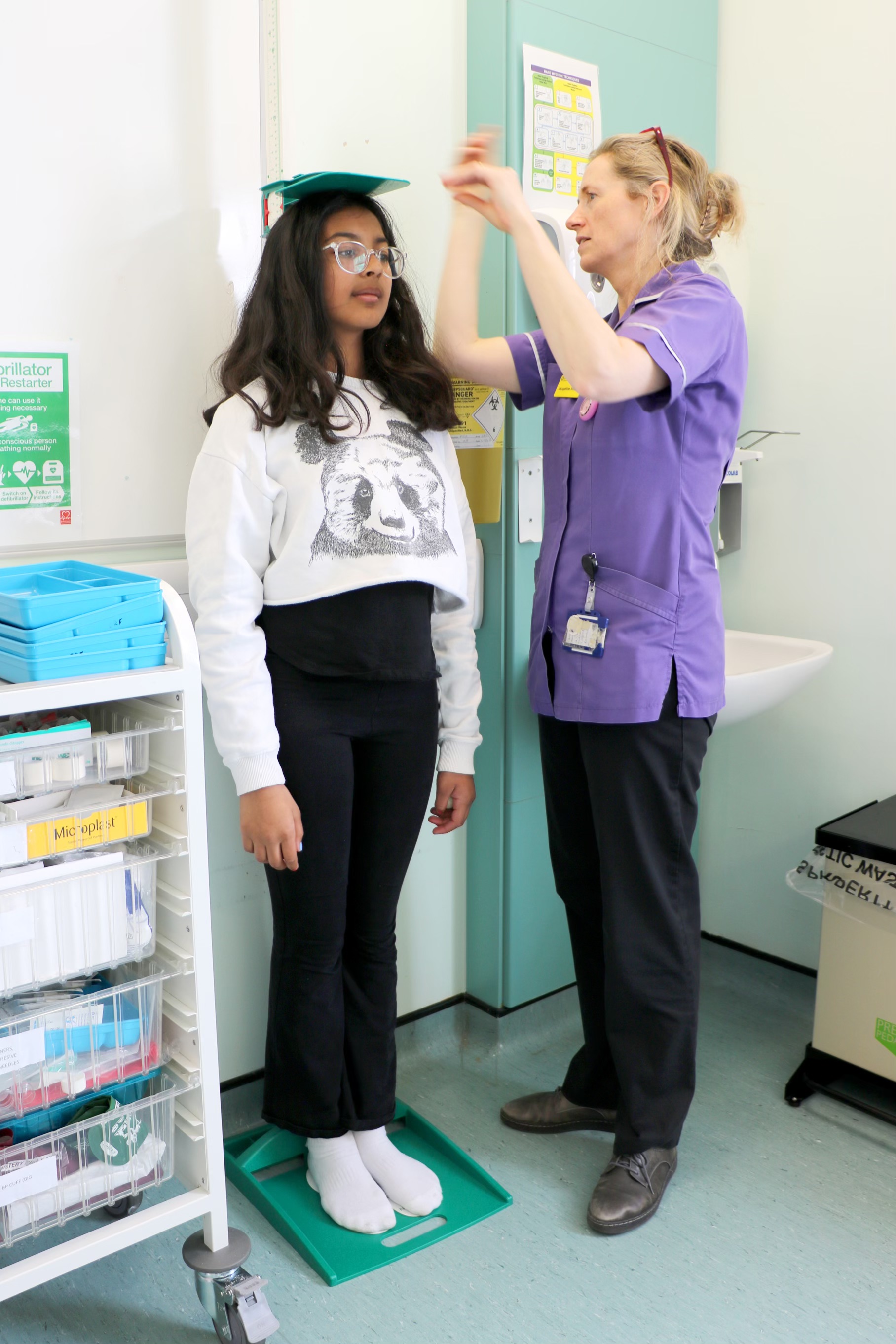 Nurse measuring height of child
I
Imaging Technicians and Photographers
Imaging technicians and photographers are trained eye care professionals who use specialised cameras and scanning equipment to take detailed images of the eye. These images help doctors diagnose, monitor, and manage a wide range of eye conditions. They work closely with ophthalmologists and optometrists, ensure images are taken safely and accurately, and help make the examination as comfortable as possible for patients. Imaging technicians and photographers also explain each test, guide patients through the process, and answer any questions during the visit.
Informed consent and assent
Why do we do this? Before you join a research study, you need to understand what will be involved and why the research is being done. You need to be able to choose whether you take part or not, once you have understood this information. Your parent/ guardian also has to agree that you can take part once they have read or understood the research information.
What do you do? You and your parent/ guardian need to have read, or had read to you, the information about the research you are thinking about taking part in. For children under the age of 16 years old, you give your assent and usually sign an assent form to say you agree and are happy to take part. Your parent/ guardian will need to give their consent for you to take part. They will sign a consent form to say they agree and are happy for you to take part in the research. Before you sign the forms, you need to understand the information. You will have time to ask questions with the person you are giving your assent/consent to.
Intraocular pressure
Why do we do this? To check the pressure inside your eyes (a bit like checking the pressure in your car or bicycle tyres). This helps us see if your eyes are healthy.
What do you do? The person doing the test might use a small machine that they hold close to your eye to measure your pressure with a little probe (like a tiny cotton bud). Try and keep your eyes wide open like you are shocked! Then look at a fixed point in the distance - don't look at the probe.
How will it feel? It doesn't hurt, people don't even normally feel it. Some people feel it brush against their eyelashes when they blink during the test.
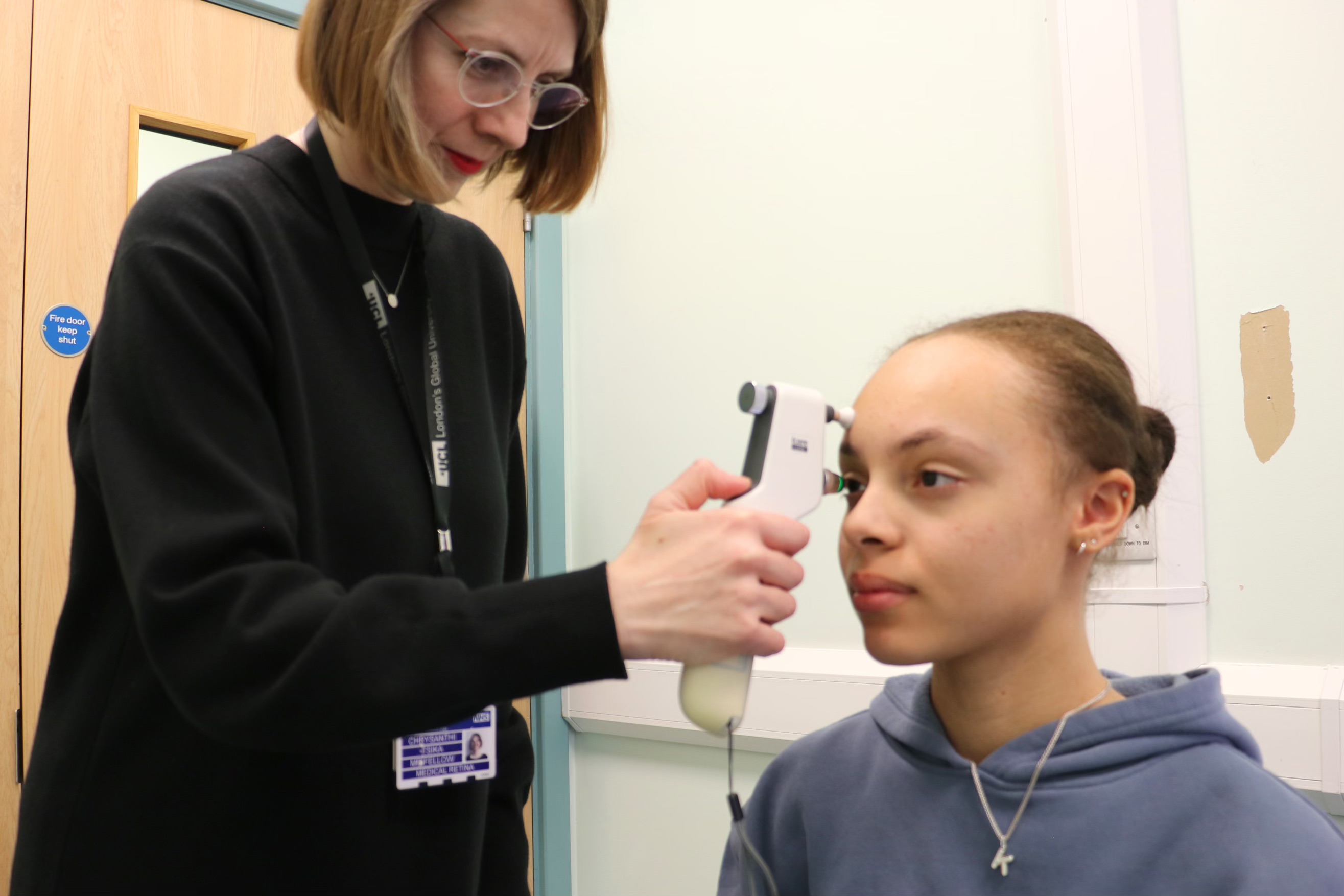 Example of clinician measuring intro ocular pressure using iCARE device
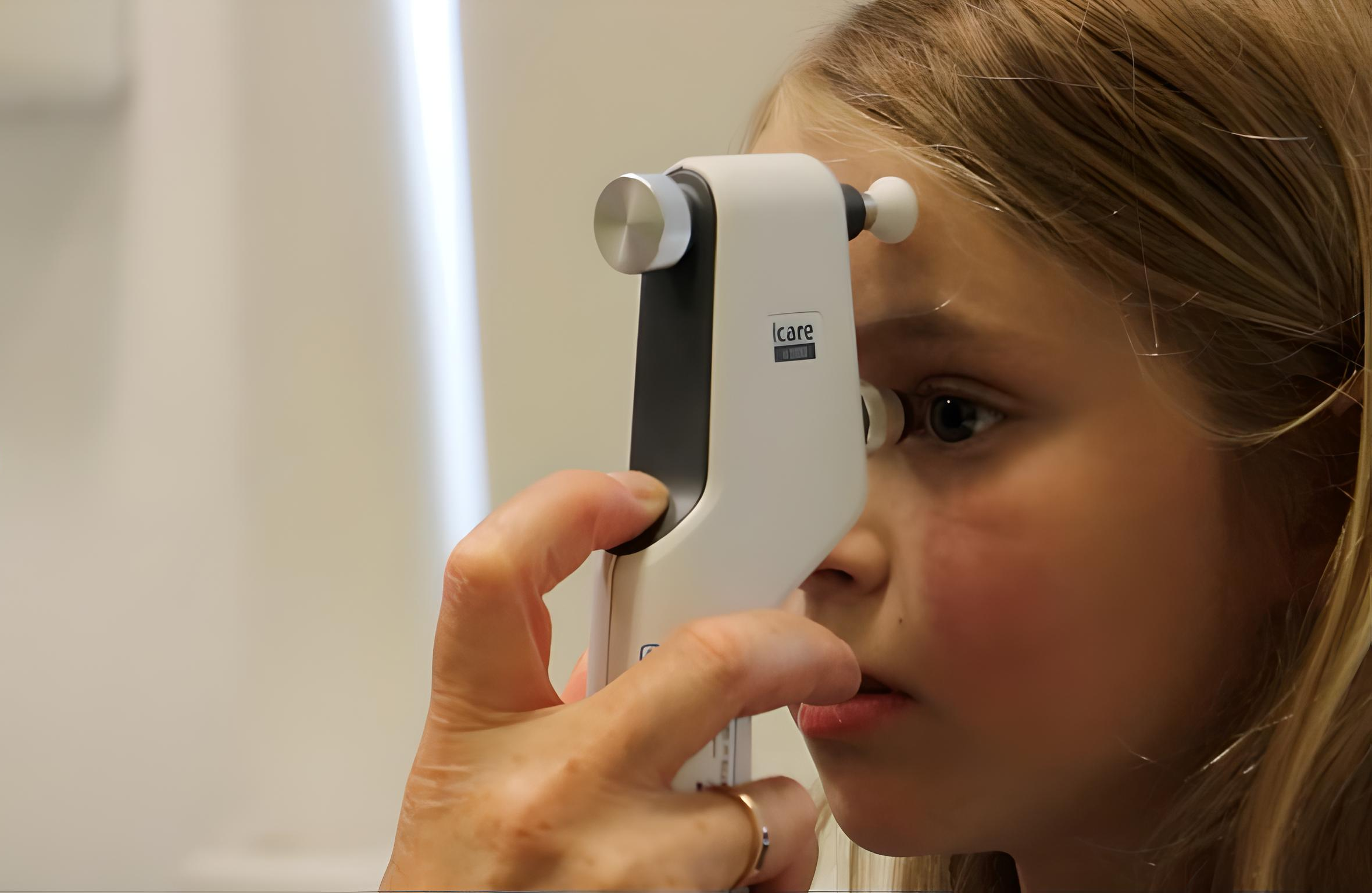 Close up example of clinician measuring intra ocular pressure using iCARE device
L
Low Luminance Visual Acuity
Why do we do this? This is to give us an idea of how well you can see in the dark.
What do you do? We will ask you to read the letters on the distance chart again but with a dark lens over your eyes or over the chart.
How will it feel? This is designed to cut out a lot of light so will make it much harder to see, don't worry if you find this a lot more difficult.
M
Medical history
Why do we do this? We will ask you and your parent/carer about what your health had been like in the past. This is so that we can spot if anything changes during your taking part in research.
What do you do? We will ask questions about your health. You and your parent/carer can tell us all you remember.
What will it feel like? It may feel like a bit of a memory test!
Microperimetry (Visual Fields testing)
Why do we do this? Like the word perimetry - we will be looking at the edges of your vision. We do this by showing you various intensities of light and working out the lowest level of light you can see (your threshold).
What do you do? You need to rest you chin on the chinrest and your forehead against the headrest, for the whole test which lasts approx. 6 minutes. We do each eye separately, so a patch (a bit like a cotton pad) will be placed over one of your eyes while the other is being tested. Your job is to keep your focus on the red circle and click when anything flashes around you. Some flashes will be bright and big and some will be dim and small - click for both!
How will it feel? This test will feel like a game, like you are catching the flashes and getting points! the time might feel longer than it actually is because you are concentrating for so long - but ask for breaks when you need it!
O
OCT (Optical Coherence Tomography)
Why do we do this test? An OCT is a scan of the back of the eye - it can show us all the layers of the eye. The researchers can look at the scan and check if everything looks healthy and if there is a change over time.
What do you do? To do this test, first you rest your chin on the chin rest and your head against the headrest. Once you are in position you will see the blue flickering light - keep your eyes on the blue light and blink as you need.
Ignore the red line.
How would it feel? You won't feel anything as nothing touches your eye, but it can be tiring focusing on the blue light. You can ask for breaks if needed. You need to look at the blue light for around 30-40seconds then - boom done :) Some people may find the light in their eye a little uncomfortable.
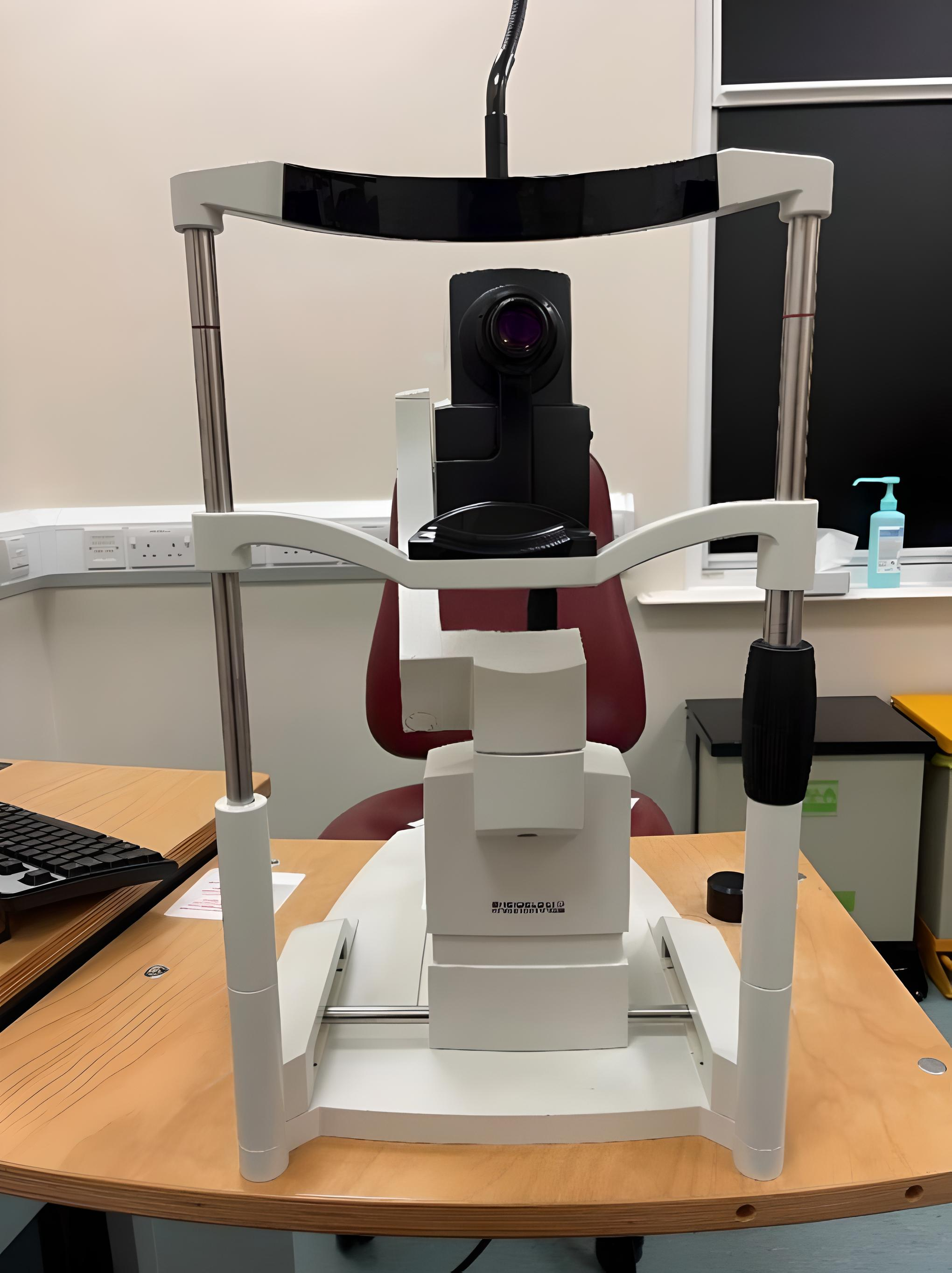 OCT Spectralis machine - chin rest view
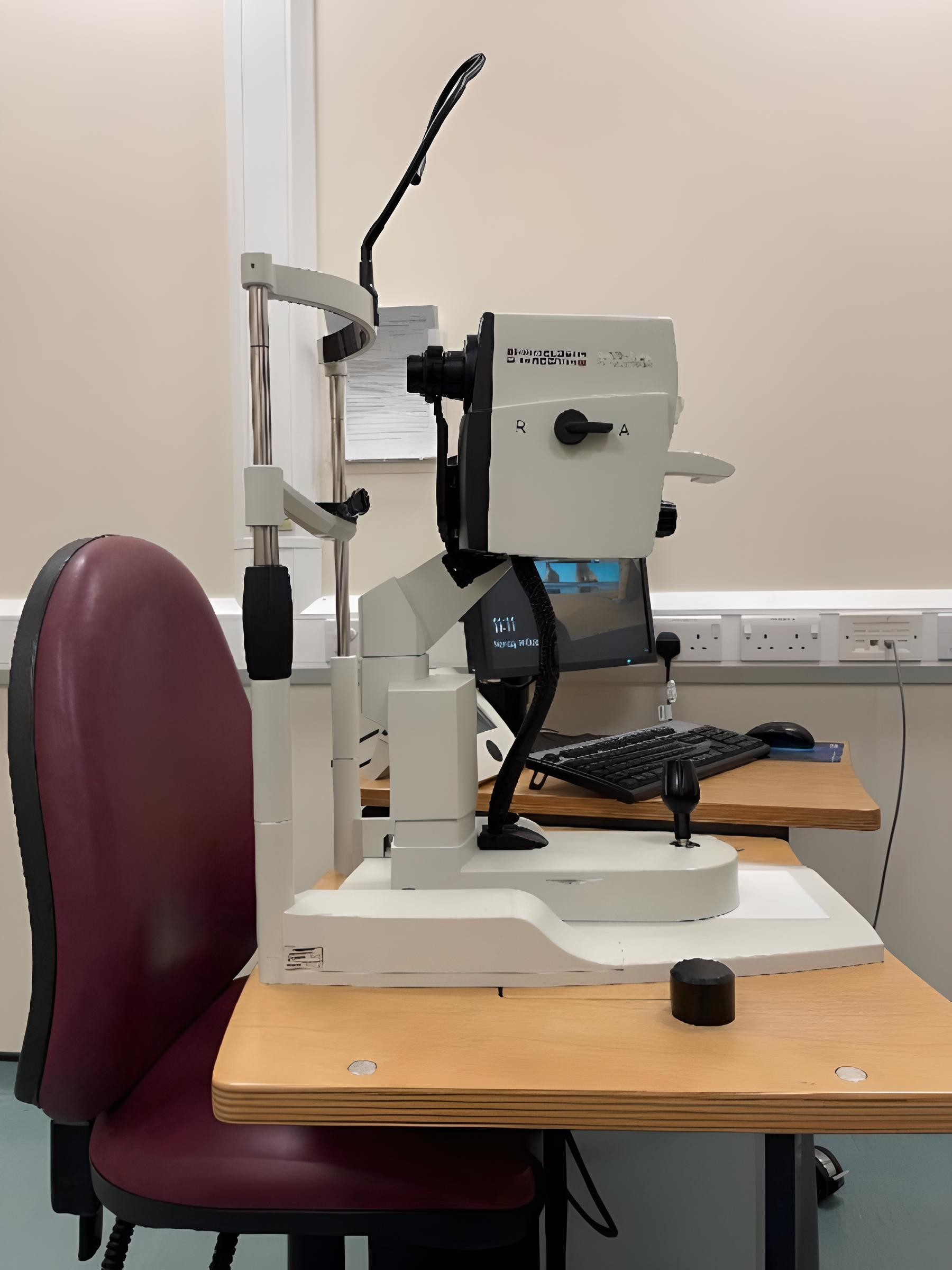 OCT Spectralis machine - from the side
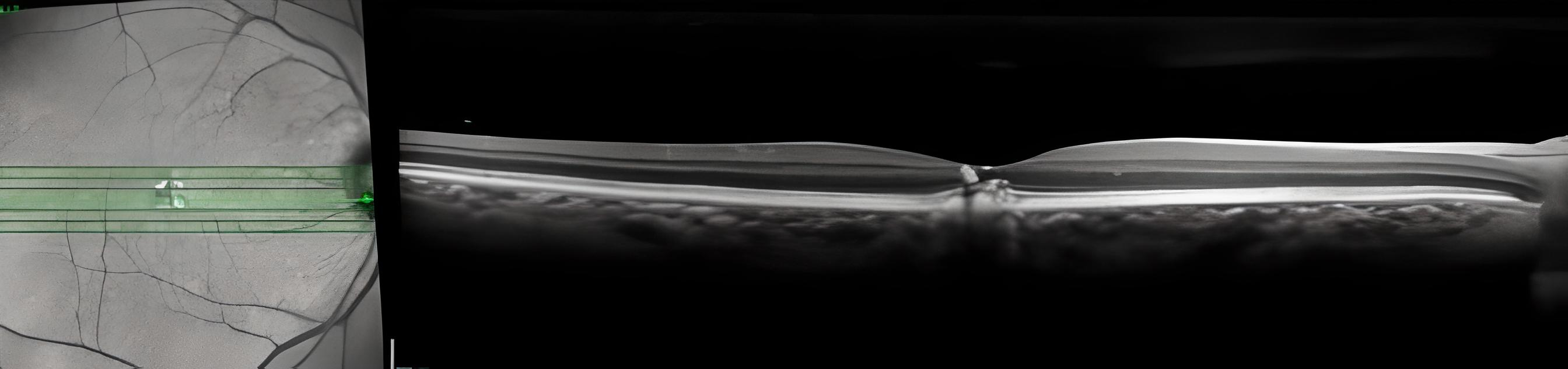 Example OCT scan
OCT AS (Anterior Segment)
Why do we do this test? This test is very similar to the OCT but we are focusing on the front layers of the eyes this time. The layers of the eyes here are more tricky to take pictures of, so we use special lens to get these pictures. We will be looking at the ciliary body, a ring-shaped structure in the eye that controls the lens's shape and produces the fluid that fills the eye body of the eyes.
What do you do? To do this test, first we place the chin on the chin rest and head against the headrest. Once you are in position you will see the green flickering light - keep your eyes on the Green light and blink as you need. Sometimes we may need to look at the edges of your eyes, we may ask you to look to the left or the right when we do this.
How would it feel? You won't feel anything, It just like looking at the green light for a bit (10 seconds) then - done!
OCT SS (Swept Source)
Why do we do this test? With this test we are still looking to the back layer of the eyes, but now we are focusing on the deeper layers (the choroid layer - which consist of the blood vessels and the muscles of the eye). These layers of the eyes require a stronger laser power, so the machine is bigger.
What do you do? To do this test, first we place the chin on the chin rest and head against the headrest. Once you are in position you will see the green flickering light - keep your eyes on the GREEN light and blink as you need.
How would it feel? This is a very quick test and you can blink throughout! You won't feel anything, just look at the green light for a bit (10 seconds) then - done!
Ocular history
Why do we do this? We will ask you and your parent/carer about what your eyes have been like in the past. This is so that we can spot if anything changes during your taking part in research.
What do you do? We will ask questions about your eyes. You and your parent/carer can tell us all you remember.
What will it feel like? It may feel like a bit of a memory test!
Ocular surface fluorescein staining
Why do we do this? We do this to check if the surface of your cornea (front part of your eye) is smooth
What do you do? We usually put a yellow drop (called fluorescein) in your eyes and then we use the slit-lamp (a microscope) with a blue light to have a good look. It makes your tears show up as a green colour.
How will it feel? The drop will feel a bit wet, but does not sting. It might make everything look yellow for a few minutes but it will go away very quickly!
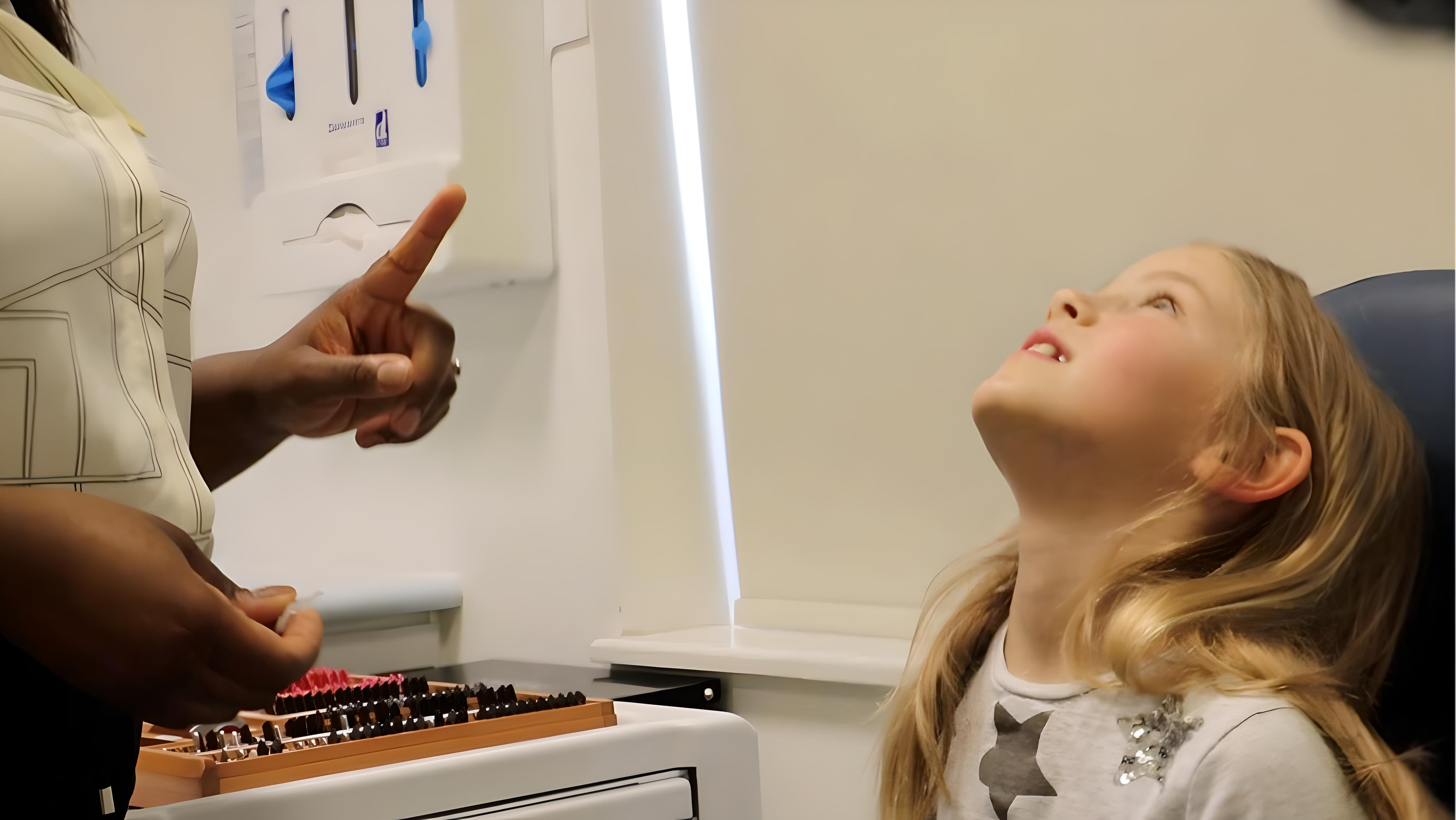
Example of child preparing for eye drop looking up
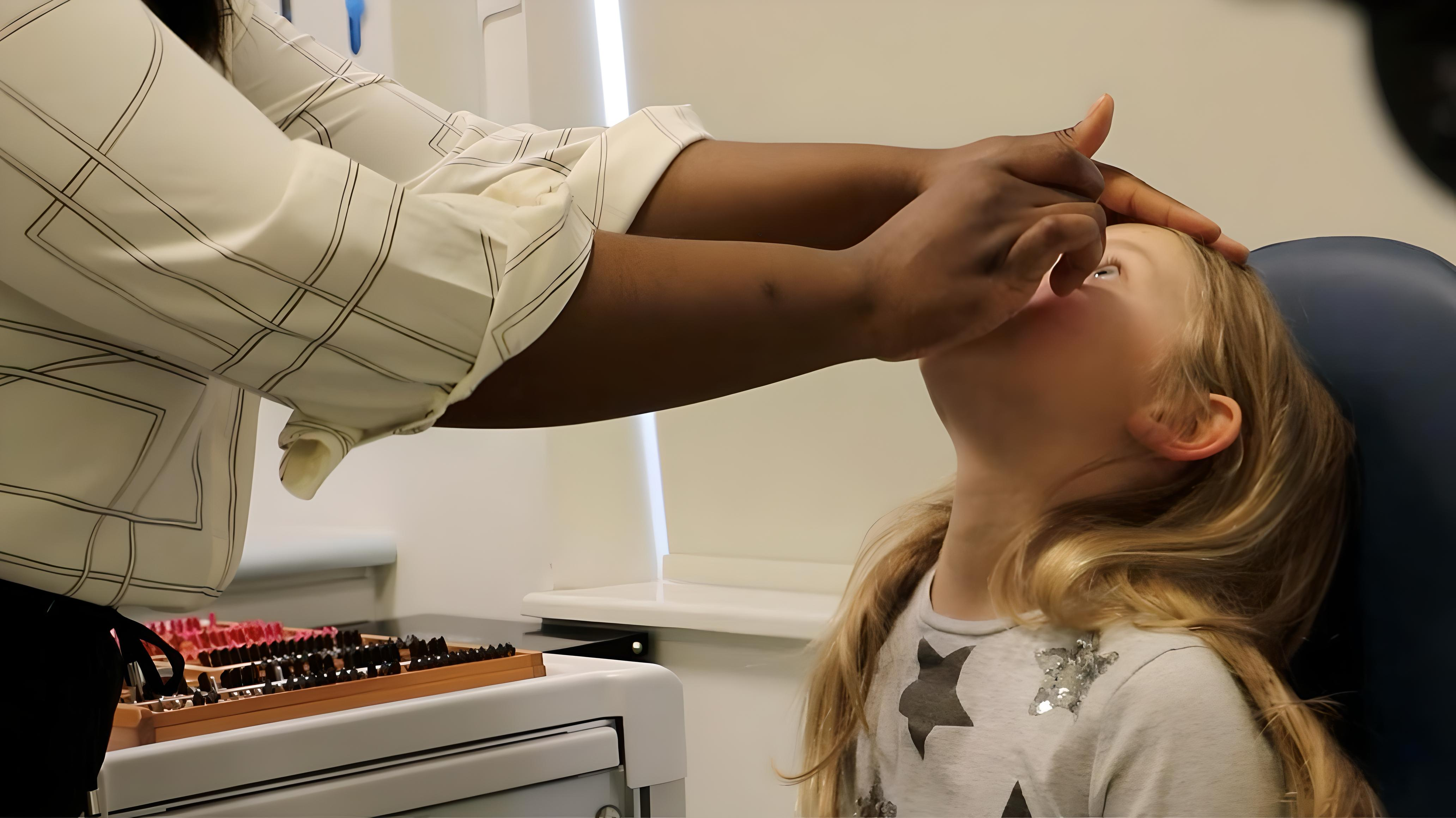 Clinician instilling eye drop as child looks up
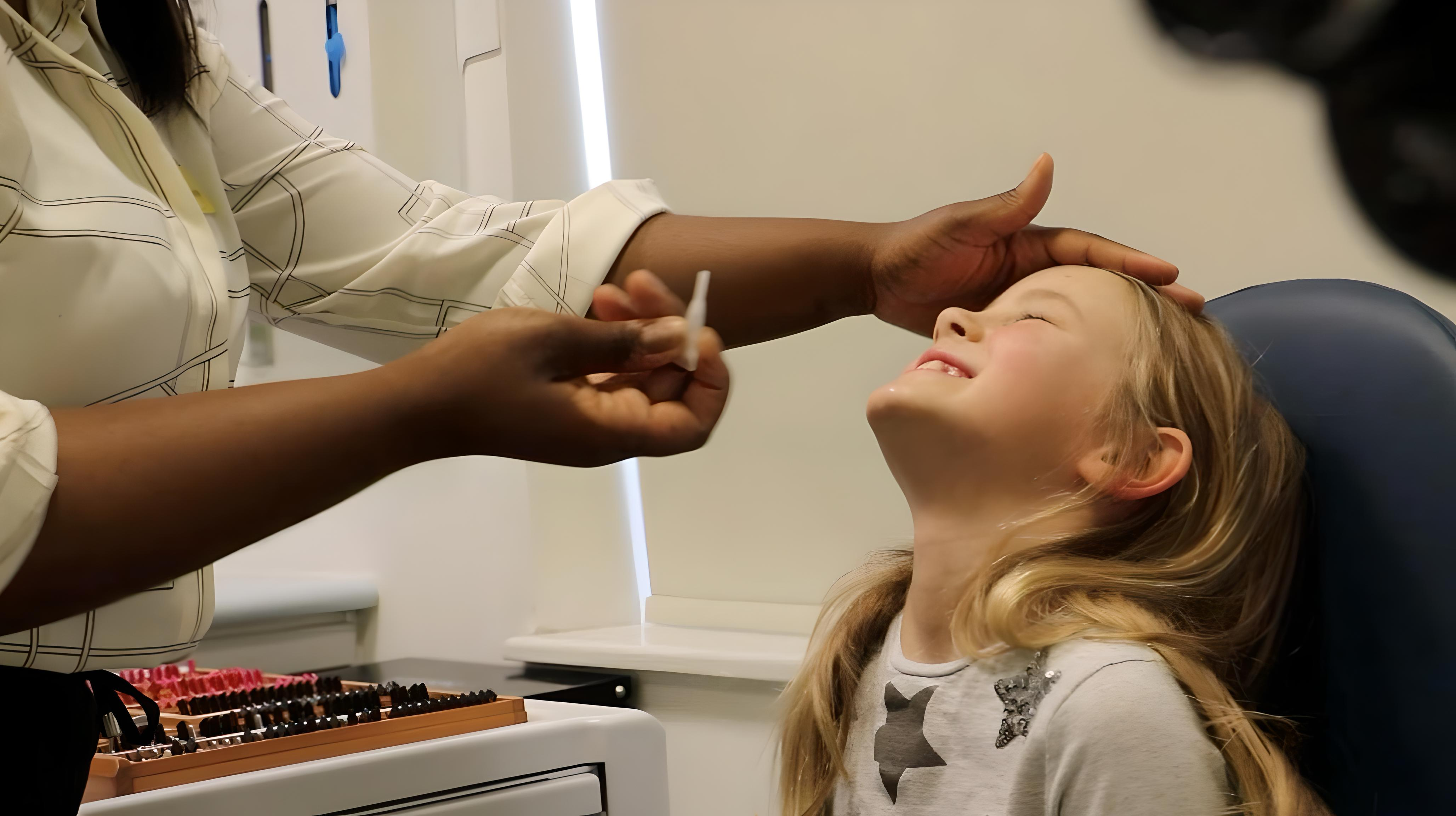 Child blinking after eye drop instilled
Ophthalmologists
Ophthalmologists (sometimes called Research Fellows or Investigators) are medical doctors who work with eyes, eye care and eye conditions or disorders.
Optometrists
Optometrists (opticians) are eye care professionals who test your eye sight (vision).
Orthoptists
Orthoptists look at eye problems that relate to the movement of the eyes and how the eyes work together.
P
Physical examination
Why do we do this? Some studies include the doctor performing a physical examination. This is so they can assess all different parts of your body from the beginning of the research and monitor for any change.
What do you do? Usually, you will either sit on the bed or lie down, while the doctor feels parts of your body, for example, your neck and tummy. They might look in your ears, nose and your mouth and listen to your heart and lungs with a stethoscope. They may examine your skin. There will usually be an extra person in the room who is acting as a chaperone, plus you can have your parent or carer with you too.
How will it feel? It might feel unusual to be examined in this way. Some assessments may tickle, for example when they feel your tummy. You can ask questions and say if you want to stop at any point or have a break. You can point out any part of your body which has changed or is different to usual and the doctor can have a look.
Pupillary light reflex
Why do we do this? We do this to check that your pupils respond to light and close up stimuli in the way we expect them to.
What do you do? We will flash a light into each eye and watch how your pupils respond.
How will it feel? The light will feel quite bright but it will only be there for a few seconds. Try not to look directly at the light- we will give you a target to focus on.
Pupil size (with a ruler)
Why do we do this? The pupil is the black disc in the centre of the coloured part of your eye. We measure it for different reasons, depending on the studies: sometimes to check how your eye reflexes work or to check if your eyes are dilated after drops
What do you do? We usually hold a ruler close to your forehead
How will it feel? You won’t feel anything unusual. Some studies will ask for your pupil size in different lighting conditions so sometimes we will measure this in the dark and while shining a bright light towards your eye for a few seconds. For this test with ruler - it is ok if you blink
Q
Questionnaires
Why do we do this? Researchers use questionnaires to find out more about your experiences. This might be related to your experience of living with your eye condition. Or your experience of taking part in the research and taking medication, for example. Most often the questions have been tested in detail to check they are valid - this means the questions make sense and are appropriate. This also means the person asking the questions has to ask them exactly as they are worded.
What do you do? Your job is to listen to the question carefully, think about and answer very honestly. This is your chance to share with the researchers what life is like for you. It is also important that the right person answers. For example, if the questions are for the child living with the eye condition, they will want the child's answers not the parents. Sometimes there is a separate set of questions for parents.
How will it feel? It might feel easy to answer the questions and it can feel quite fun. Sometimes it might feel a bit awkward/uneasy if the questions are a bit sensitive. Take your time and answer honestly. If the questions make you feel upset or worried, please tell someone in the research team and we can help you. Sometimes you might not understand a question. That is no problem, just tell the person asking the questions and they can write that down so the researchers know the questions weren't easy for you to understand. This is not uncommon.
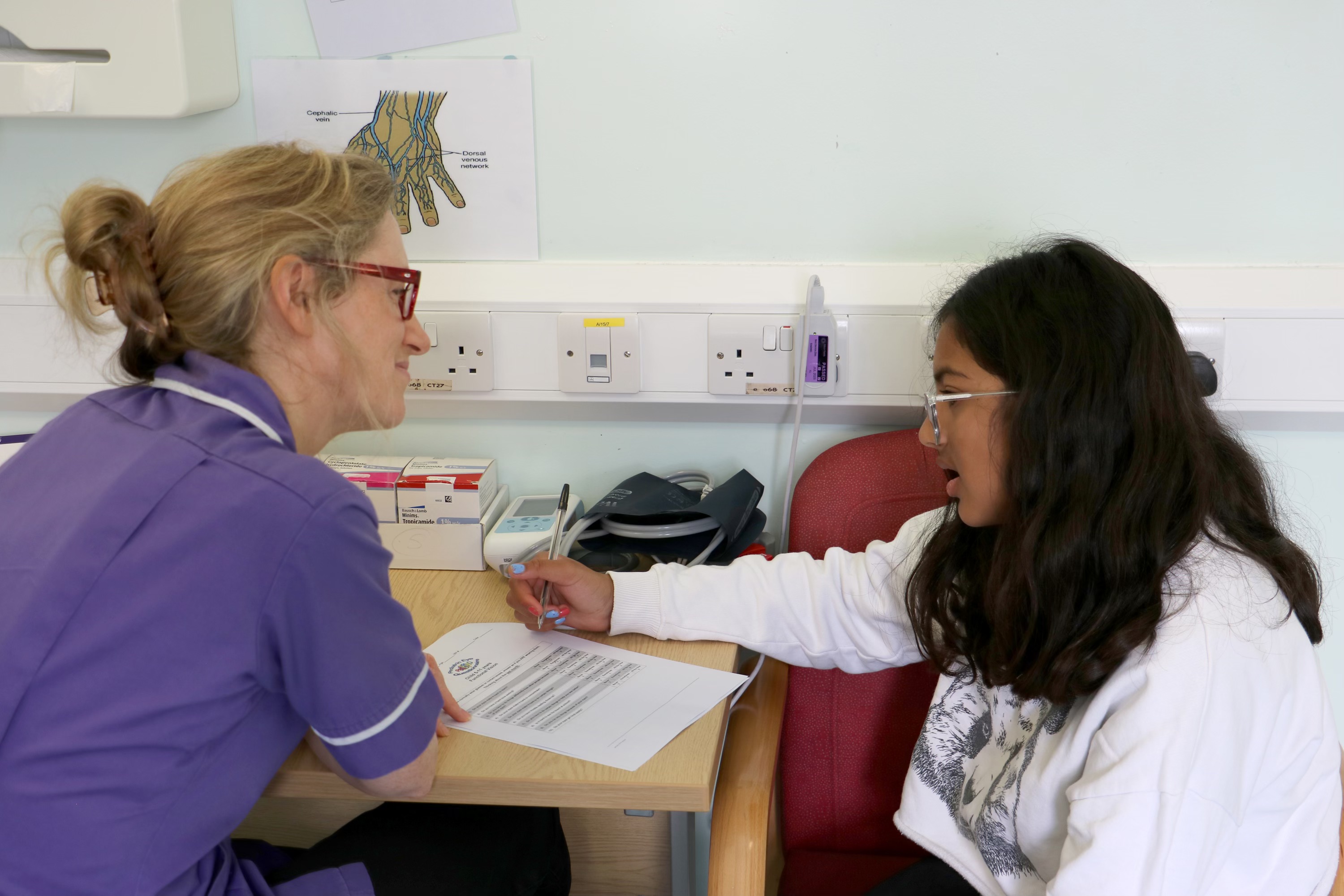 Example of a nurse supporting a child to complete a questionnaire.
R
Randomisation
Why we do this? 'Randomised trials' have at least 2 different groups of treatments. The people taking part are put into one of the groups at random. The process of putting people into random groups is called 'randomisation' and is usually done by a computer. The project information should tell you what chance you have of being in the different groups. You can also ask about this.
What do you do? You don't need to do anything. Sometimes you will know which treatment group you have been put in, and sometimes you won't know, depending how the research is designed.
How will it feel? You might know which group you would prefer to be in, or you might not mind, or you might not find out until all the research has finished. You may be happy or disappointed with your group if you find out. We hope that you understood what the chances were of being in the different groups and are not too disappointed.
Re-consent and re-assent
Why do we do this? Sometimes if there is a change (amendment) to the research, we will need to give you new information to read/watch listen to, and then ask you if you understand the changes and would you still like to be involved. Or sometimes when you get older, there is information for older children to read and understand and decide again if you are happy to continue in the research.
What do you do? You and a parent/guardian will need to read/watch/listen to the new information and then probably sign a form again to say you agree (after you have had the chance to ask any questions).
Reading acuity
Why do we do this? We do this to measure the smallest letters you can read up close.
How do we do this? You will be sitting at a table and we will ask you to read letters (or sentences) of different sizes. We will tell you how close you have to sit from the paper/book.
How does it feel? It will be get harder as the letters gets smaller ! Don’t worry if you don’t see all the letters/words. Just try your best!
Reading Speed
Why do we do this? We do this we get an idea of how comfortably you can read. The researchers will look how this changes for you over time.
What do you do? We will ask you to read sentences (or words) as quickly and as accurately as you can. Sometimes the size of the words get smaller and smaller with each sentence.
How will it feel? Some of the sentences make sense and some of them don't. Don’t worry if you don’t recognise or see all the words. Just try your best!
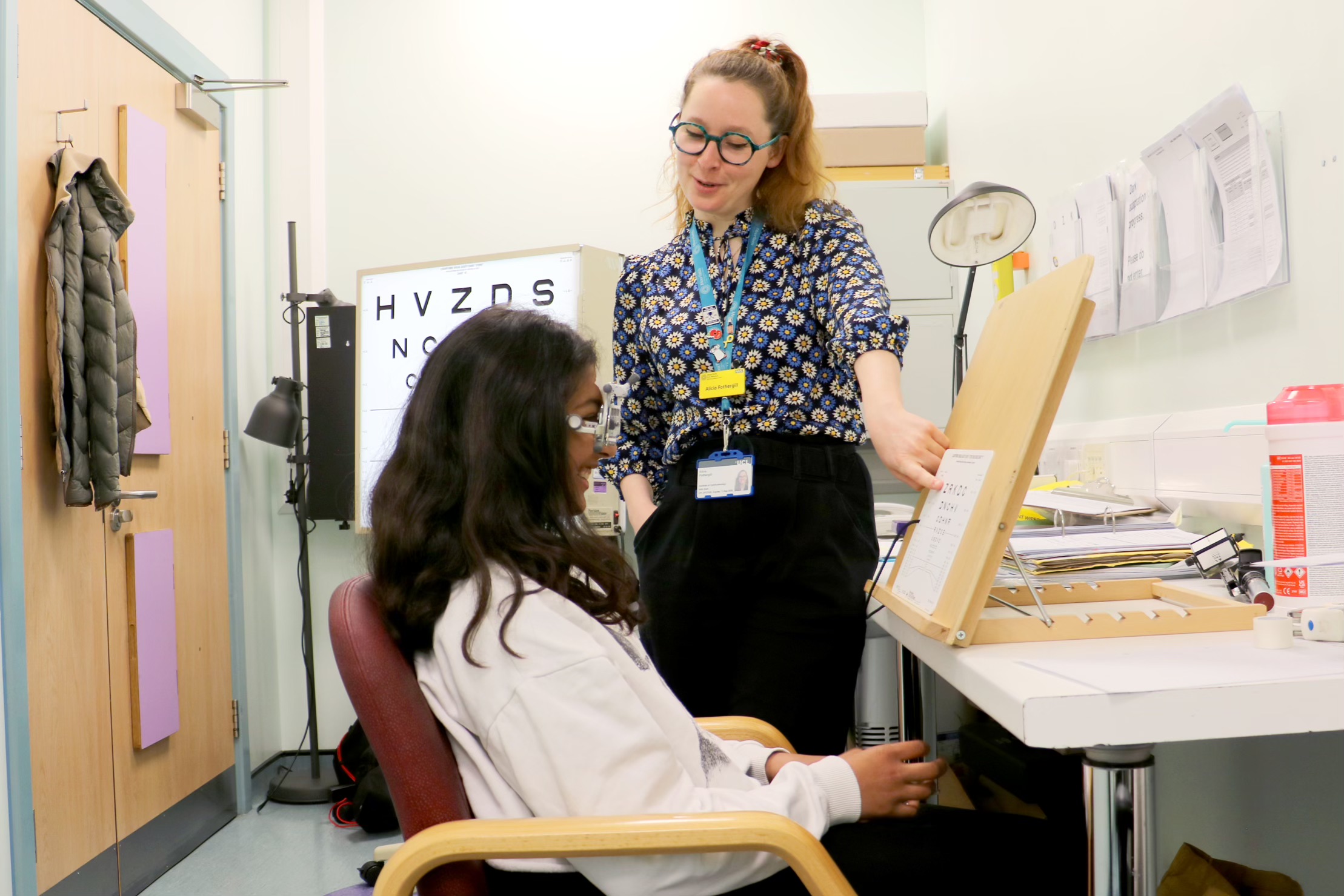 Example of a child completing a reading speed test
Refraction
Why do we do this? To determine what lenses you need to be able see as clearly as possible.
What do you do? We can do this in two ways:
We will ask you to look at a coloured target while we shine a light in your eye and hold up different lenses.
We will ask you to read small letters on a chart and tell us if lenses make them look better or worse.
How will it feel? We will ask you to wear a special pair of glasses that may feel heavier than your normal glasses. We may also need to shine a light in your eyes to complete this test.
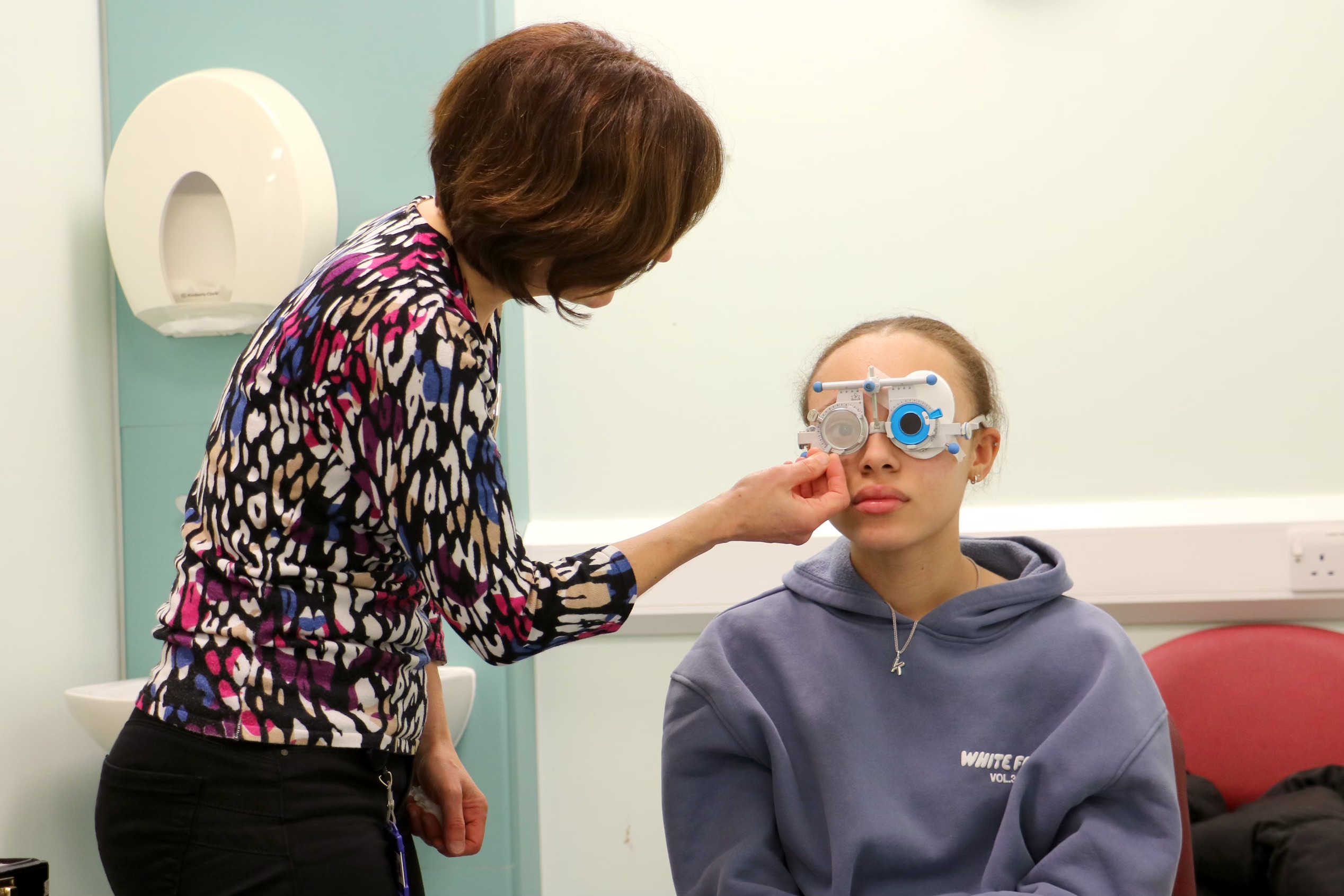 Example of child wearing special ‘trial’ glasses for refraction
Respiration rate
Why do we do this? We may count how many breaths you take per minute. This is usually part of a whole healthy body check.
What do you do? You sit and rest in a chair and we will count the number of breaths you take in a minute. Usually when you are not looking so you don't focus on your breathing.
How does it feel? Usually you won't notice us counting your breaths.
S
Slit lamp biomicroscopy
Why do we do this? A slit lamp is a special machine that shines a bright light and lets the eye doctor see different parts of the eye in more detail. Imagine a magnifying glass that helps a doctor see inside your eye.
What do you do? You sit in a chair and rest your chin on a ledge. The doctor will bring the machine closer to your face, shine a light into your eye and use lenses to see different parts of your eye. You will be asked to look in lots of different directions, up, down, left, right for example.
How will it feel? It can be very difficult to have the light shine straight in your eye, but you are allowed to blink, which can help.
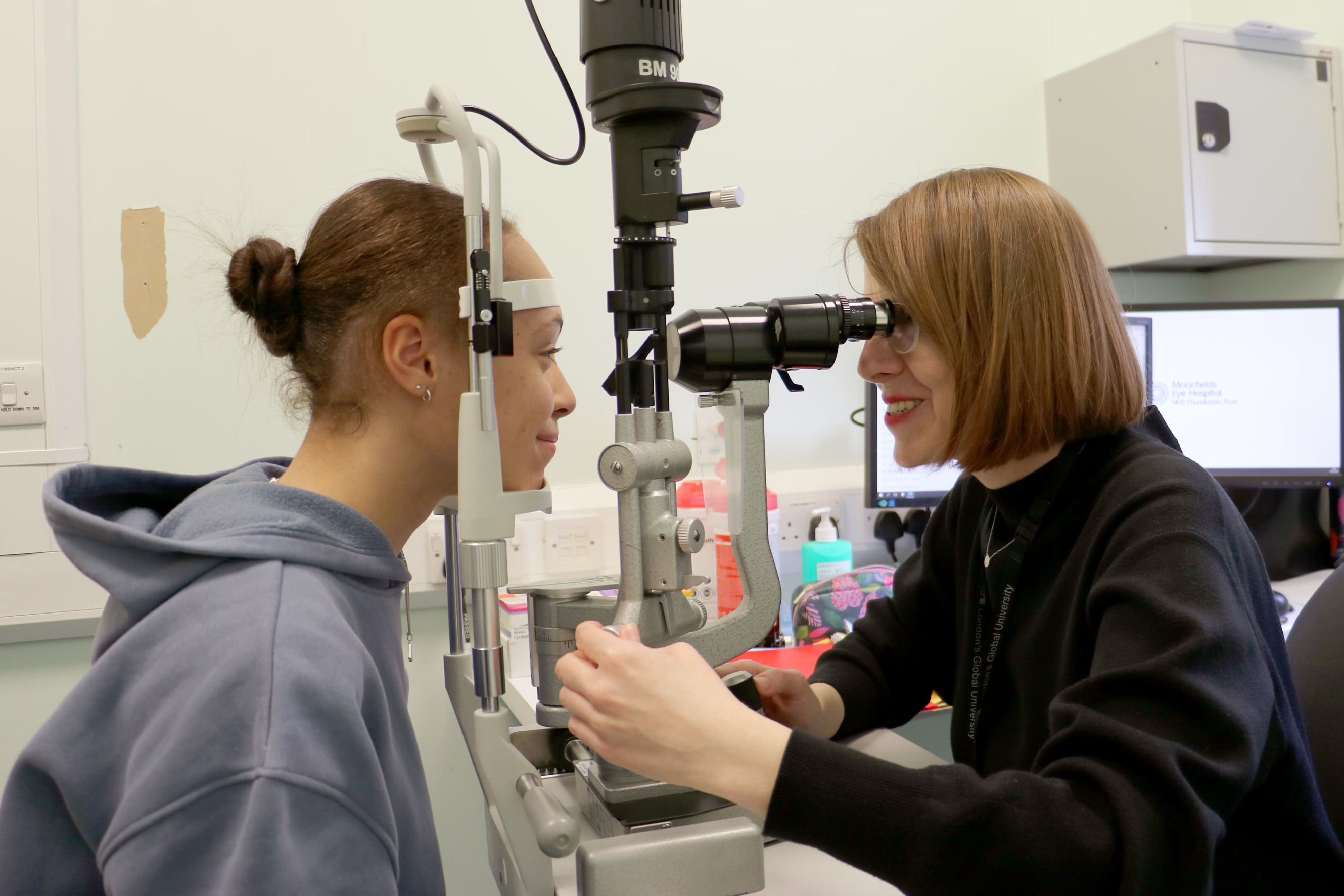 Example of child completing slit lamp biomicroscopy from the side view
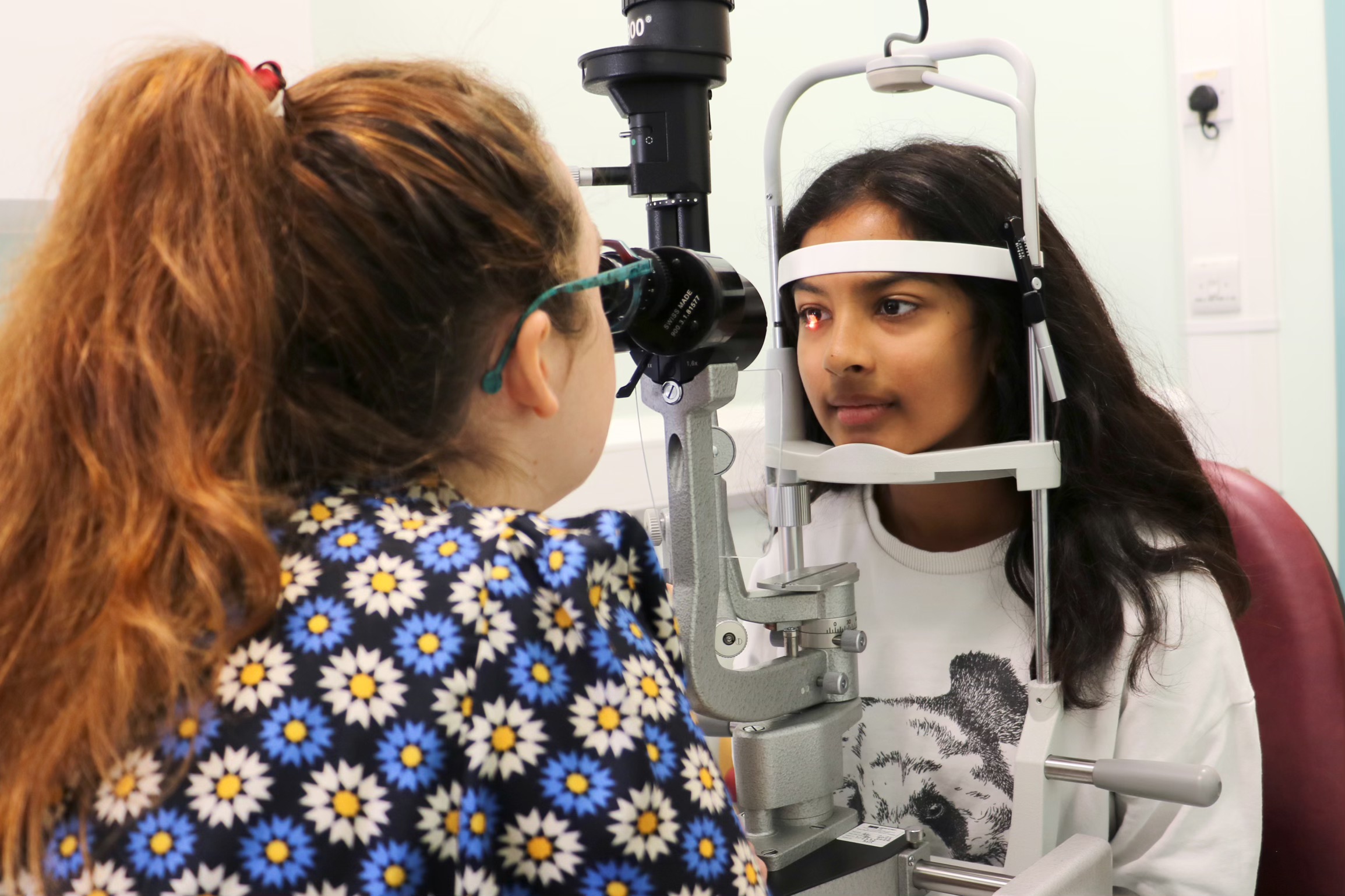 Example of child completing slit lamp biomicroscopy showing light shining in eye
Specular Microscopy
Why do we do this? You are made up of tiny building blocks called cells. The front of your eyes have very special cells called endothelium. Endothelium have a very important function in keeping your eyes healthy and working well. We will be looking at the shape and size of those endothelium cells in these pictures.
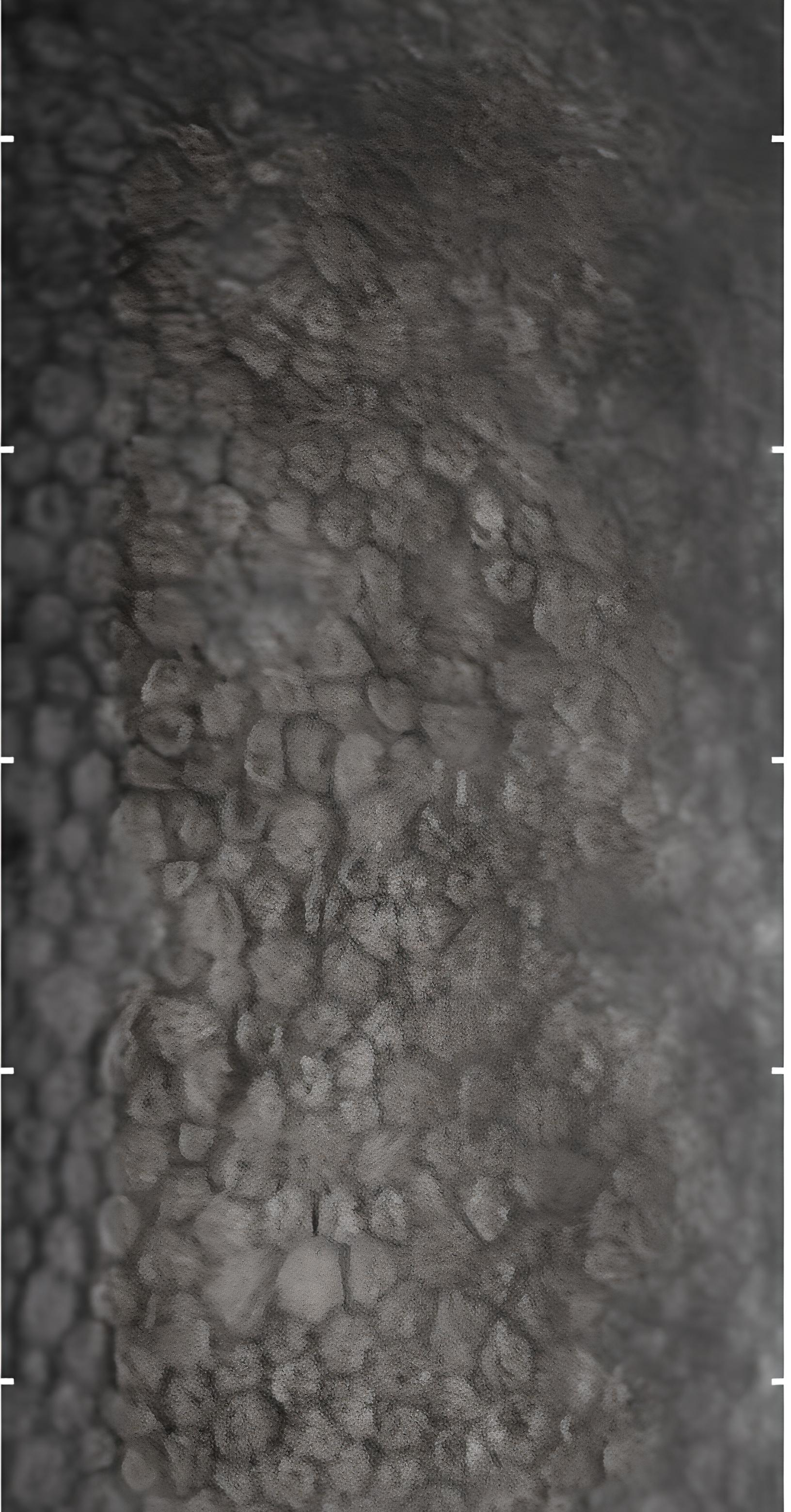 Image of endothelium cells
What do you do? Like all our imaging machines - it is important to keep your head as still as possible, so you need to keep your chin still on the chinrest and your head still on the headrest. With your eyes, look at and orange light straight ahead. There is a microscope on the inside of the machine; this will take a picture of the eye (a bright green flash!). Hold still for this!
How will it feel? You might find that your eyes are getting tired by this point and you may be feeling a bit bored, but this is the quickest of tests and you just see a quick green flash and then you are done!
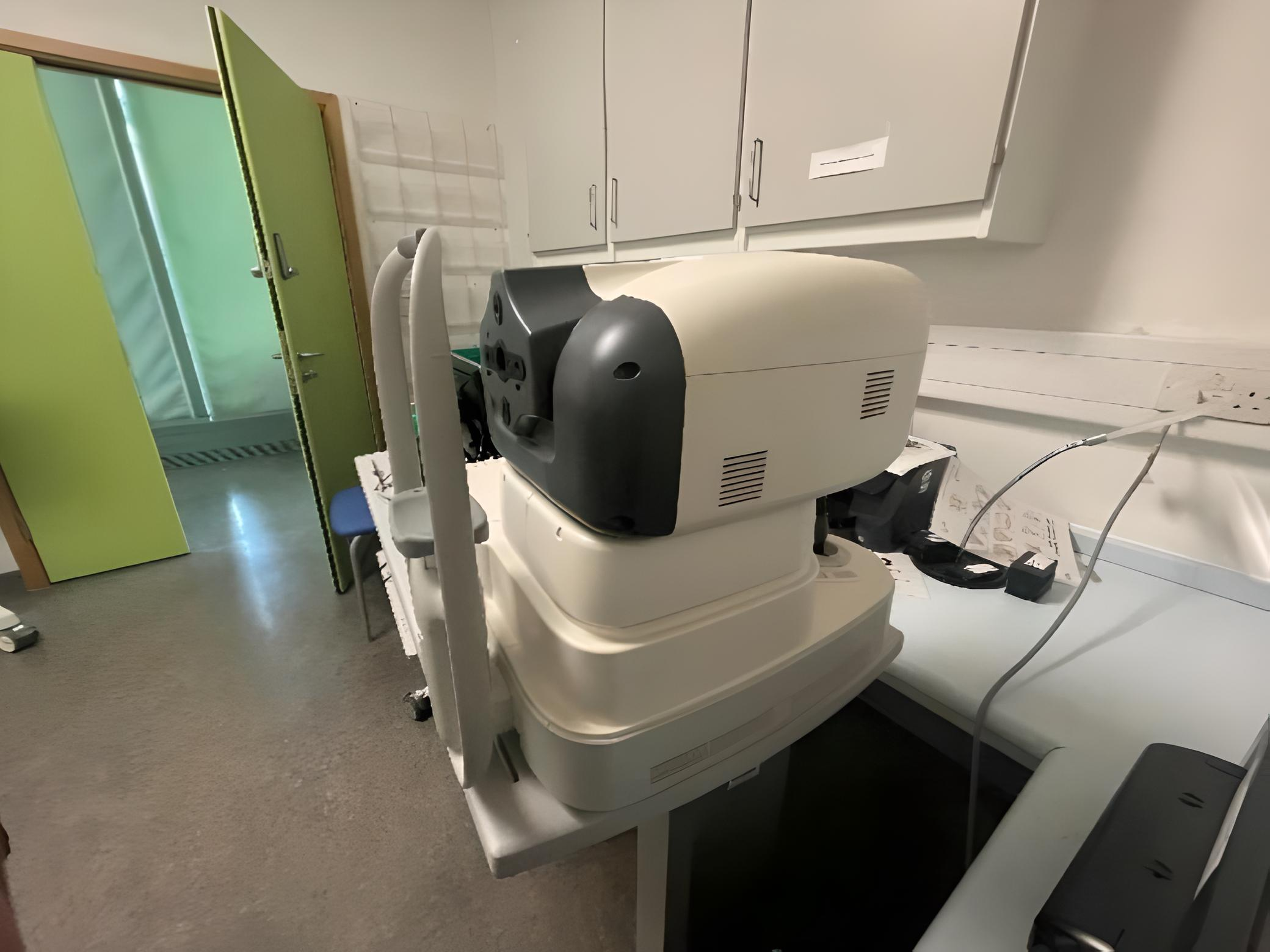 Specular Microscope Machine from side (can see chin rest on left of machine)
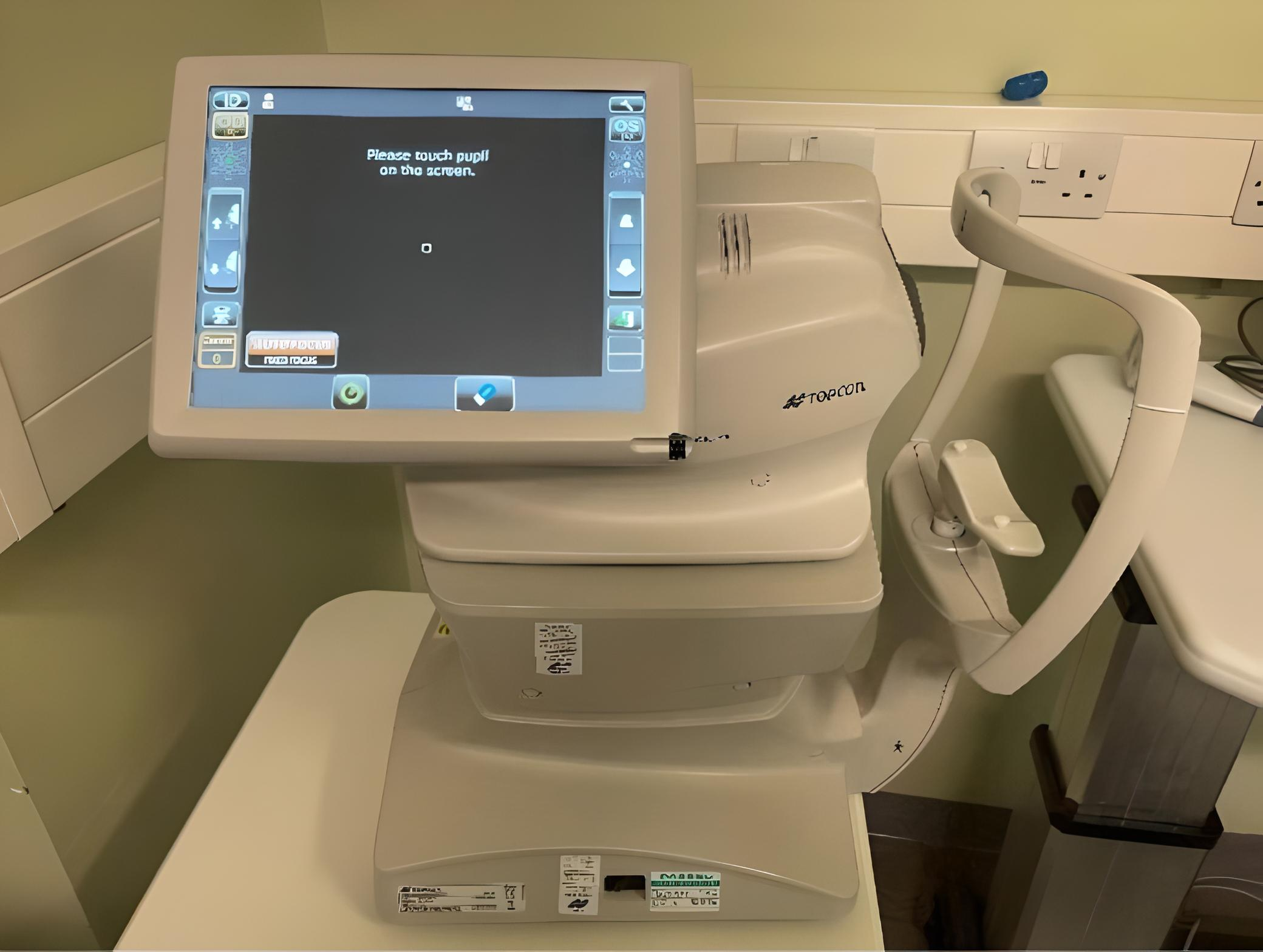 Specular Microscope Machine operator view
T
Temperature
Why do we do this? As part of a full body health check, we may take your temperature to see how hot or cold your body is.
What do you do? You can sit in a chair and relax. The nurse will use a machine which takes your temperature from your ear. They will press a button on the digital ear thermometer, then put the probe gently a little way into your ear. The machine will beep and your body temperature will be displayed on the machine.
How will it feel? You will just feel the probe in your ear but it doesn't hurt at all. It may tickle.
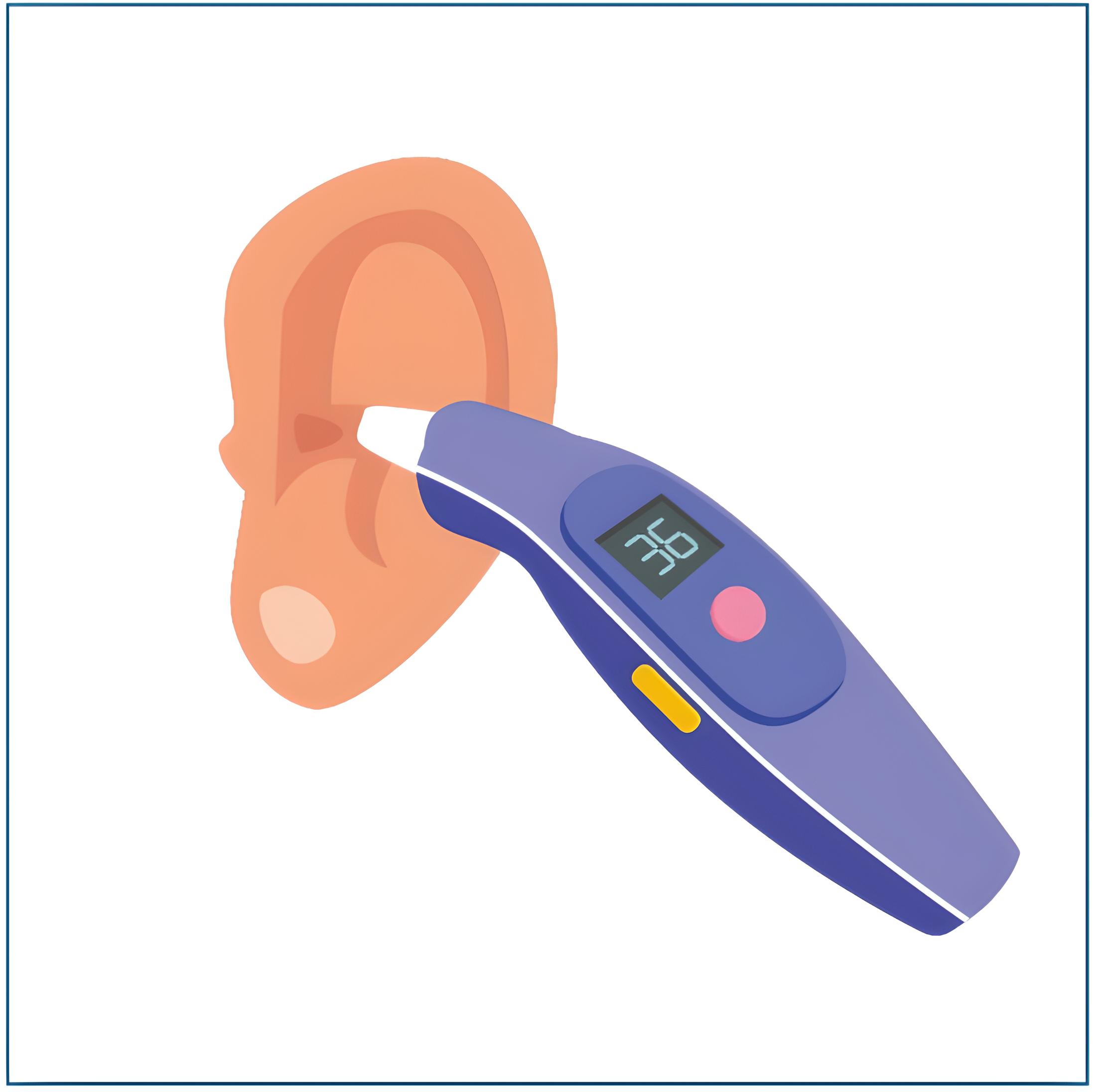 Image of thermometer measuring temperature from ear
Training (medication or diaries or anything else)
Why do we do this? Sometimes in a research study you need to do new things at home between visits, like take new medicine or eye drops or complete diaries. The nurses are usually the people who show you how to do these correctly.
What do you do? When a nurse is giving you and your parent/carer training, you need to listen and then ask if you have any questions. It is important that all research activities are done correctly at home.
How does it feel? It may feel a bit like being in school with a teacher. Hopefully not too boring! There are no silly questions, so please ask us lots of questions. We are very happy to explain things in different ways until you understand what we are asking you to do.
U
Urine test
Why do we do this? Sometimes we ask you to wee into a small bottle so we can run some tests on your urine. These tests can tell us information about your body and how healthy it is. If we do regular urine tests we can look out for any changes.
Sometimes, we will ask females if we can use their urine to do a pregnancy test at a research visits. This might be because we don't know much about how the research medicine effects babies or pregnant women, so we would need to know if a female was pregnant. If pregnancy testing is included in your research, it will be listed in the information you read about the study. You can discuss pregnancy testing when you discuss giving your assent ('giving your assent' is telling us whether you agree to take part or not, once you have understood what is involved and why).
What do you do? You take a small bottle to the toilet and try and catch your wee in it. It is best if you start to wee into the toilet, then catch the middle stream of your wee, to half fill the bottle, then the rest of your wee can go in the toilet. Put the lid on the bottle. Try not to touch the inside of the bottle with your fingers. Then you bring the bottle back to the nurse who will take it for testing. If you feel uncomfortable walking down the hall with the filled bottle, you can wrap it in tissue to hide it a bit or we can give you a bag to put it in.
How does it feel? It may feel a little hard or embarrassing to wee into a small bottle. However it is very normal and lots of people do these tests every day. It may be a bit embarrassing handing your wee bottle to the nurse. Again don't worry, nurses do these tests every day and find it very normal. Tell us if we can help you feel more comfortable. Also tell us if you have questions about pregnancy testing.
W
Weight
Why do we do this? In research we usually measure children's weight so the researchers can see if treatments make a difference to how much your body is growing.
What do you do? We will ask you to take off any heavy clothing and shoes. We will also ask you to remove anything heavy in your pockets. We will then ask you to step onto the weighing scales and stand still - the machine will show us numbers which will tell us how heavy you are.
How will it feel? You are probably used to standing on weighing scales. Sometimes you can feel a bit wobbly standing on the scales to start with, until you find your balance.
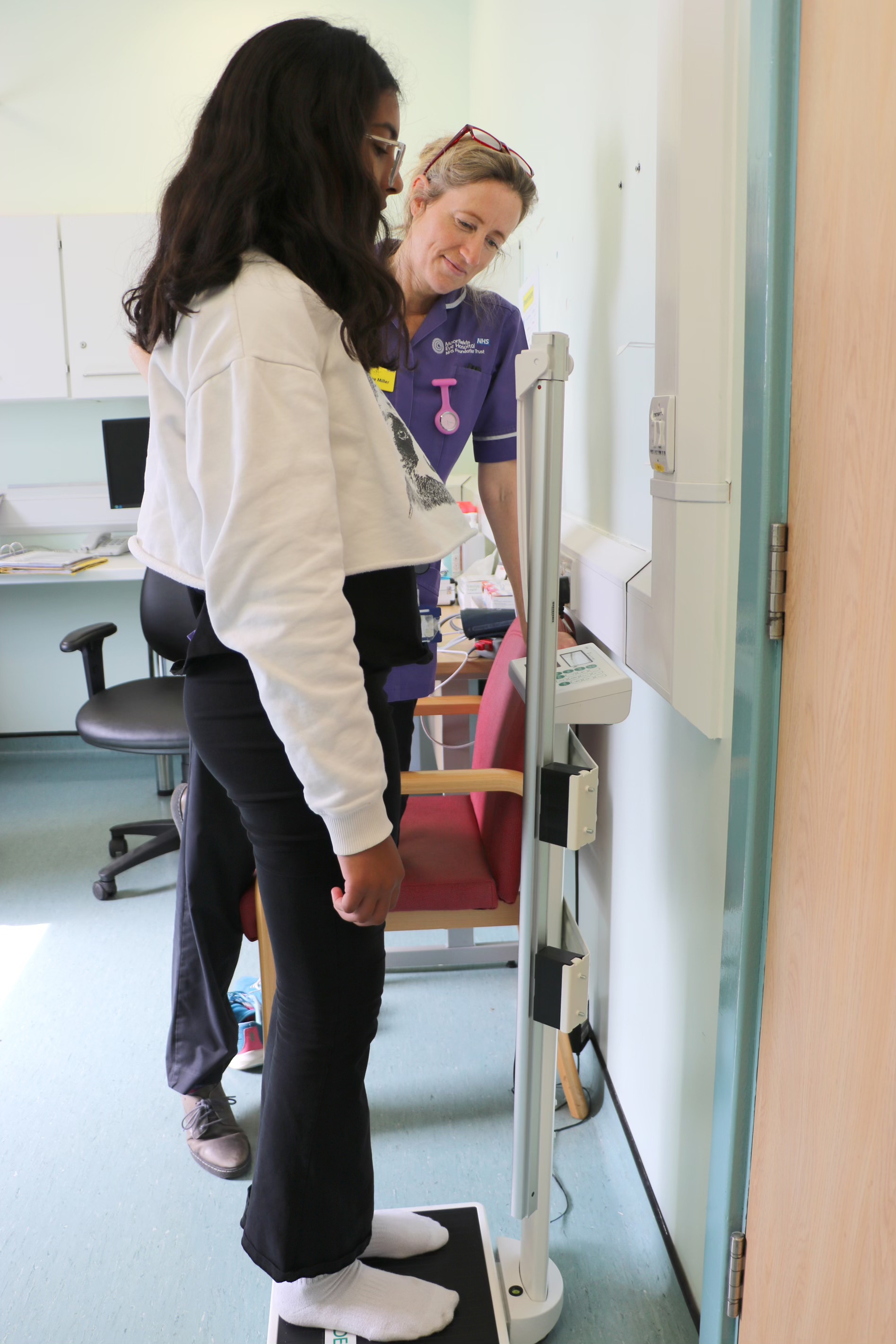 Nurse measuring child’s weight